

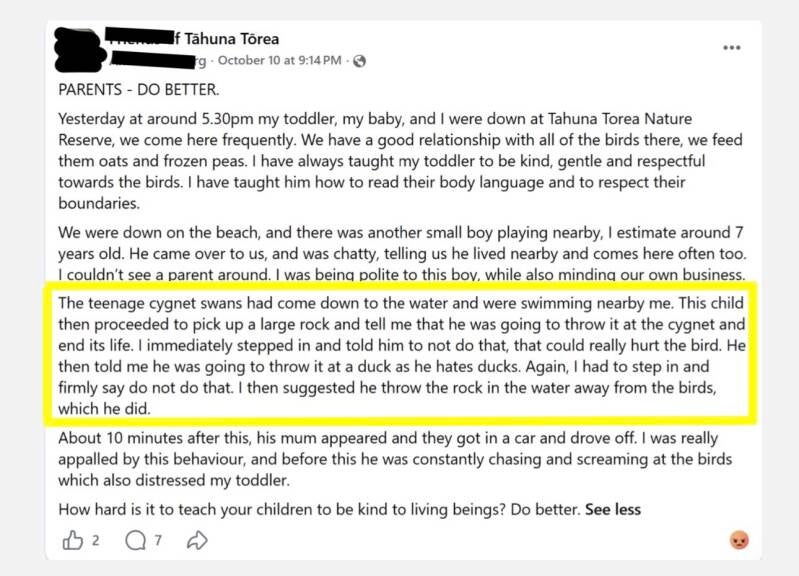
This was not how I was planning on beginning this page, but having found the below post tonight, dated just 10 days ago, it perfectly captures the reason why confronting and dispelling this local rhetoric and hate campaign matters now more than ever.
St Heliers & the black swans
PRESS COVERAGE - nz herald, seven sharp, radio nz
In late June, early July of 2026, I was approached by a journalist, who - having stopped to enjoy the swans in St Heliers on her way home from work - had observed my interactions with them and wanted to know my story. How is it that they come in en masse when they see me, and seem to know me so well.
Over the following weeks, journalist Jane and Cameraman Cameron spent time with me to capture that relationship. The week it was due to be published, I had attended a public local residents meeting as I had heard that there was anger toward the swans presence in St Heliers. What was said at that meeting was so distressing to me that I had to leave the building. This rhetoric, and the points being raised, were summarily addressed and dismissed by experts in the final article that was published.
Included in the interviews were the relevant representatives from Department of Conservation, Council Biodiversity, Fish & Game and a Professor from the University of Auckland. All successfully debunked the myths and 'concerns'. All asserted there would be no culls, that taking a life was not - and should not be - done unless absolutely necessary for high level issues that St Heliers residents' mere dislike did not meet, and confirmed that the long standing waste water and pollution issues had long pre-existed and lay squarely at the feet of the human species.
NZ Herald - Weekend Herald - 11 July, 2026
NZ Herald digital and physical articles and videos.


NZ Herald Digital - 10 July, 2026
The response from the wider community was largely one of warmth and compassion for the swans, and shock and anger at the cull proposal.
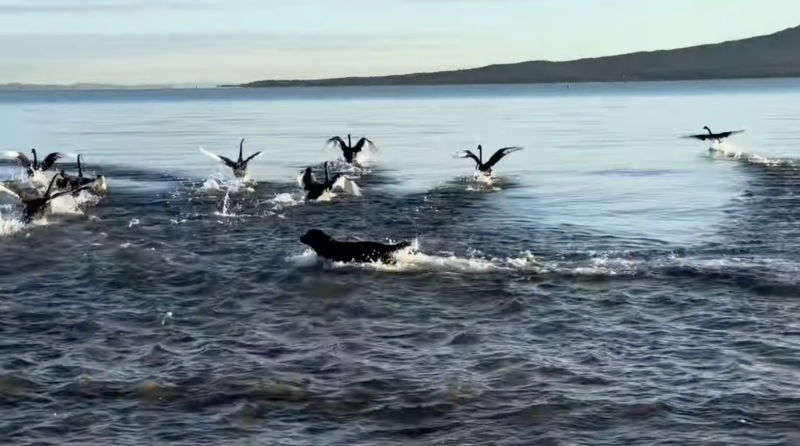
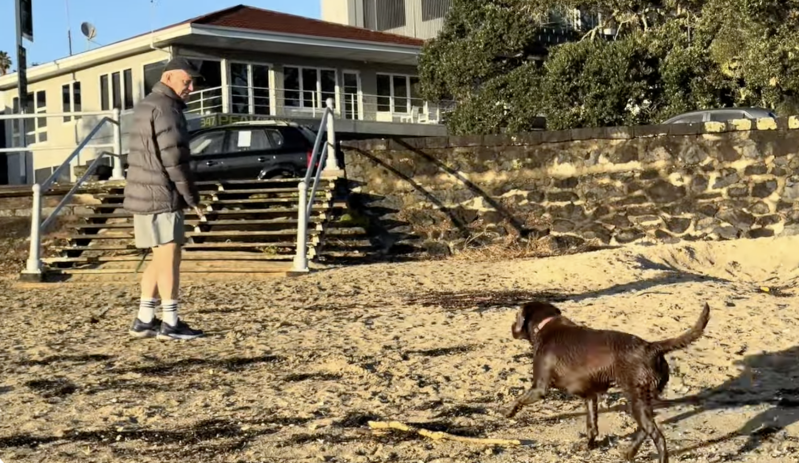
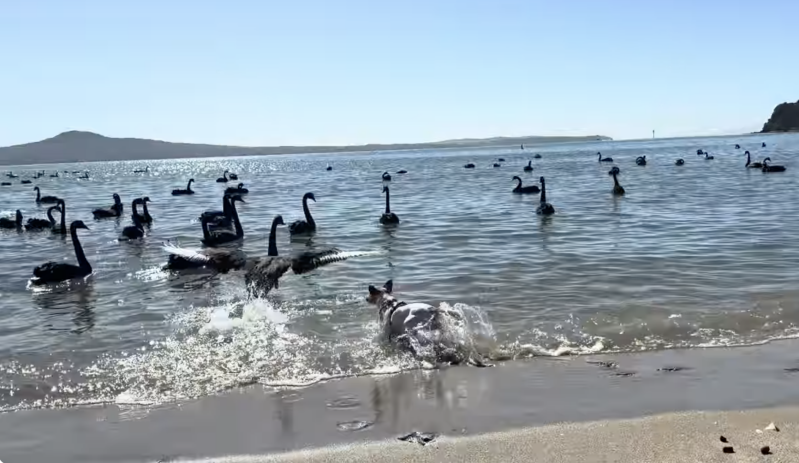
The response from the cull-proposing local residents was to hurl further myths and misinformation, deny the experts positions and to generally find ways to project their anger onto myself and the swans, both on social media and in person. There was an immediate, and deliberate increase in abuse toward the swans with local efforts to harass, terrify and disturb them as often as possible, primarily through weaponising their dogs to run at, chase and, in at least one reported instance, to fatally maul the swans.
For context, at the time this was unfurling, a large number of the swans - primarily a pod of young and juveniles under the age of 3 - were going through their annual moult, a fact made obvious by the many feathers on the beach in easy view of the public. I observed on multiple occasions very small, and often dramatically undernourished, swans furiously paddling in the ocean to try and evade capture by dogs who were easily gaining on them. It was absolutely devastating to watch them unable to fly and rapidly tiring in open ocean conditions, while the dog owners stood on the beach watching, enjoying and doing nothing to change the outcome. Despite my repeated pleas for them to call their dogs back, I was met only with expressions of delight at what was transpiring or responses that the swans 'shouldn't' be there or that they weren't 'wanted' there.
One comment on a Neighbourly post was so wilfully vile that it almost brought me to tears, but sums up the attitude perfectly:
"I saw a black Labrador chasing them today. Made me smile. Hope it gave them a fright." - "Karen Deynzer from Mission Bay"
Animals suffer extreme distress when they are victim to attacks by dogs and abuses by humans. To hear someone say that they smiled when witnessing something so intentionally cruel and malicious was beyond comprehension and spoke volumes about the person who posted it, and the eager audience of like-minded individuals who choose to remain wilfully ignorant or ambivalent to the facts, science, laws and Rights of animals in NZ.
The swans only crime was to have tried to live in one of the few areas where there is a fresh water source they can access for only a few hours a day, but which serves as a critical resource determining life or death.
There have now been at least six swan maulings in the past few years that I have been made aware of, locally. 4 of those in St Heliers. Only one we were able to save.
St Heliers Residents flouting dog control act
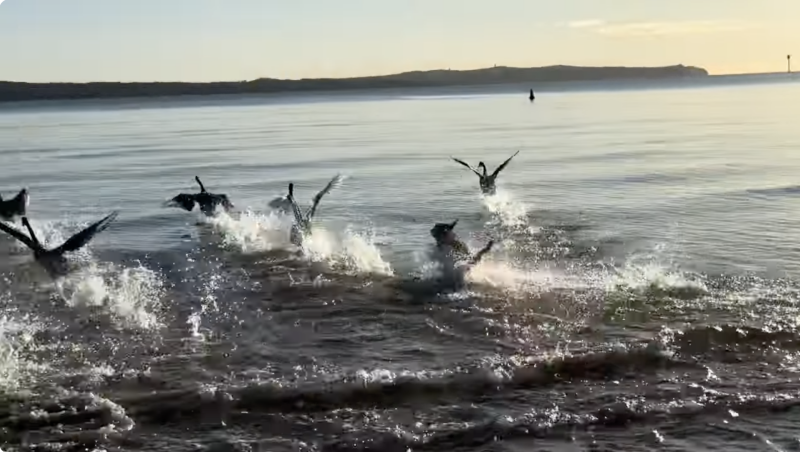
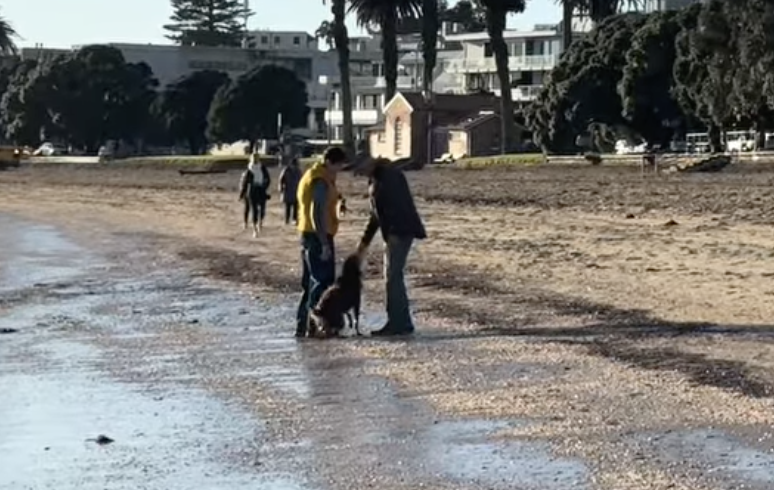
Images:
(L) Dog chasing young swans resting on St Heliers beach.
(R) Owners giving dog treats after he is finished chasing the swans.
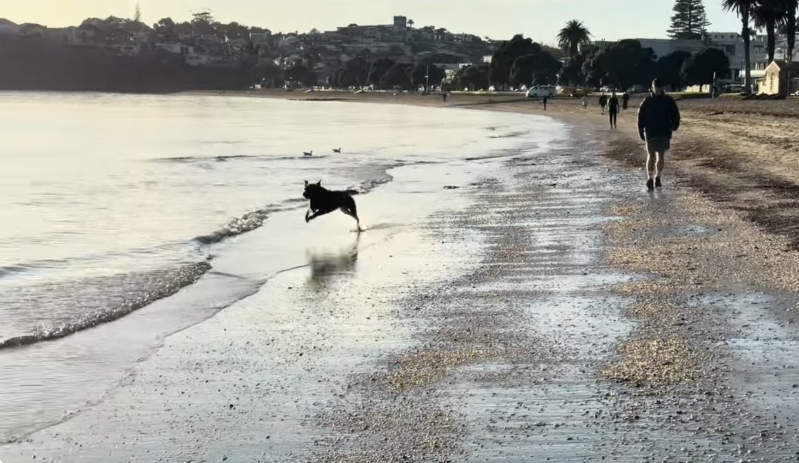
Images:
Top (L) and (R): Dog chasing young swans resting on St Heliers beach. Owner makes no attempt to stop him or call him back.
Bottom (L): Owner smiling after having watched his dog chase the swans
Images:
(L): Dog chasing swans resting on St Heliers beach
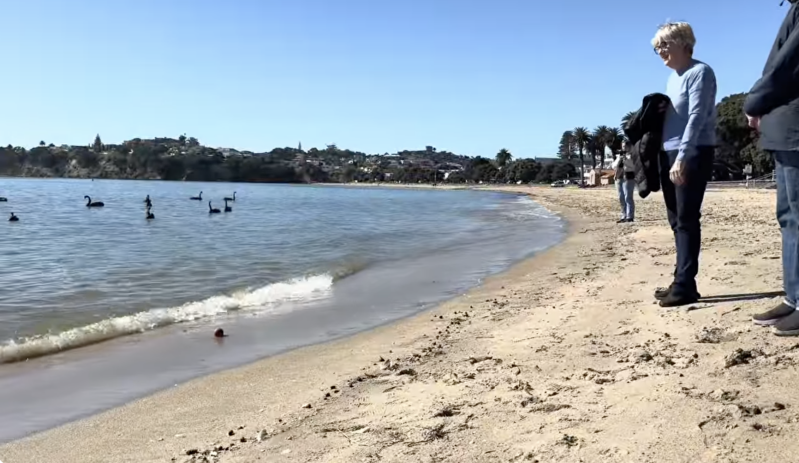
(R): Owner watching and not attempting any call back or intervention
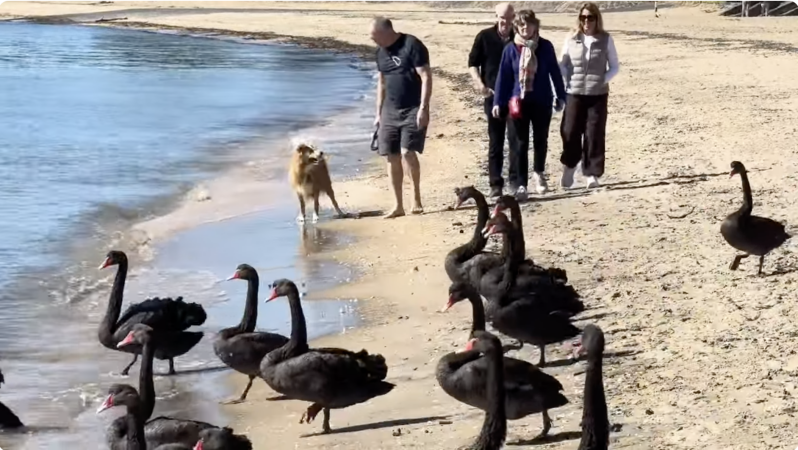
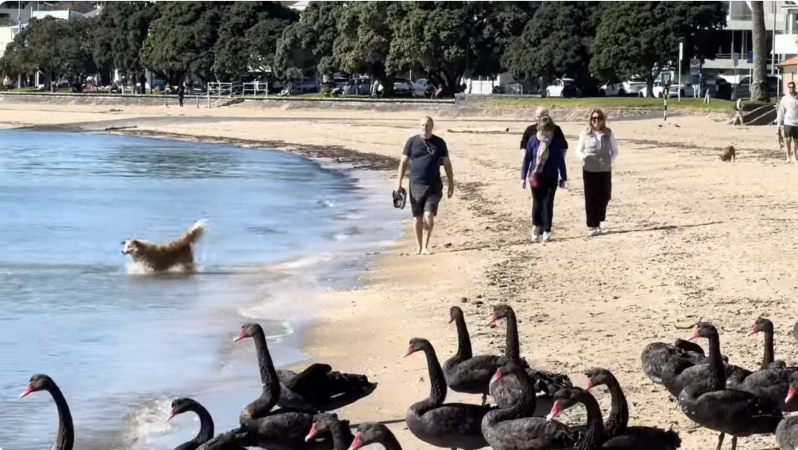
Images:
(L) and (R): Owners leading dog up to swans resting on St Heliers Beach.
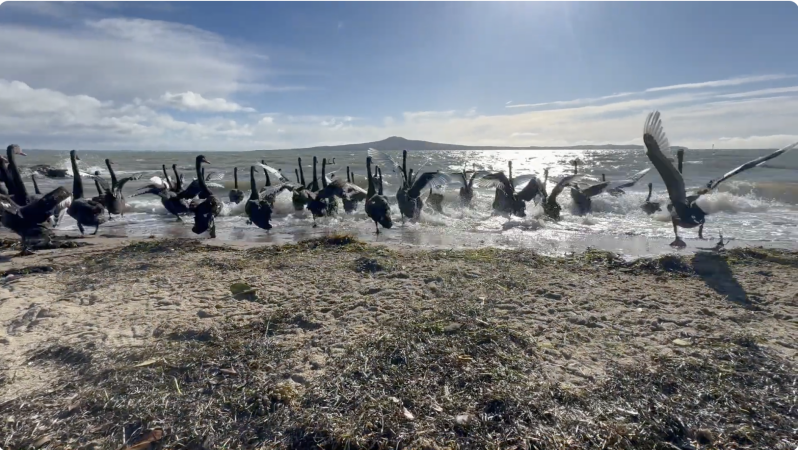
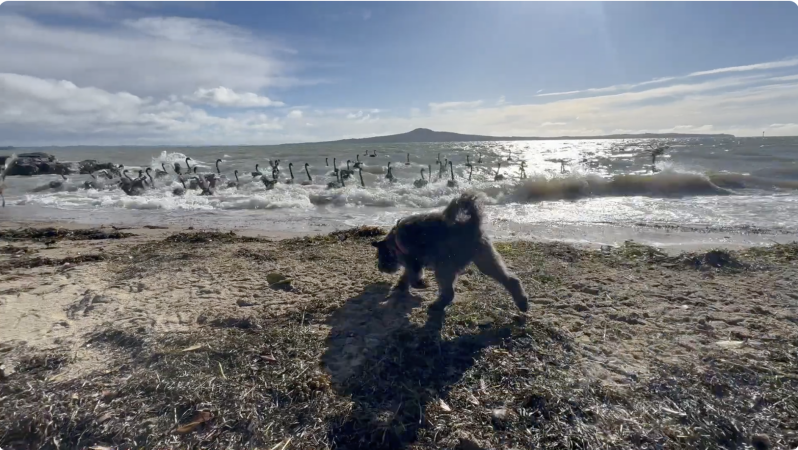
(Above and left):
Dog chasing swans resting on St Heliers Beach.
Following the story's release, I was contacted by producers from Radio NZ and Seven Sharp, both of whom had seen the article and wanted to follow it further. In particular, Seven Sharp wanted to honour the original story without the politics: my relationship with the swans and how they came to change my life. What resulted was a love letter to my grandfather, my spiritual practice, my healing relationship with nature and the beautiful animals at the heart of it all.
Again, the wider community largely loved the story. The same local community groups doubled down on the abuse and rhetoric.
Seven Sharp - 10 August, 2026
Radio NZ - The Panel - 22 July, 2026
(starts 6m52s)
And then this...
Orakei Local Board Press Release misinformation
On the 28th and 29th September 2026, a disturbing press release was issued via Newstalk ZB by local elected Orakei Local Board Member Margaret Voyce. In this article, she specifically targets the swans in St Heliers and Okahu Bay.
The nationally broadcast article features a photo of me, which states "Voyce said there were a few people who were feeding the birds which were causing them to breed at higher rates. What it does is it creates a human subsidised wildlife population, for example they're breeding twice a year which isn't usual for a black swan."
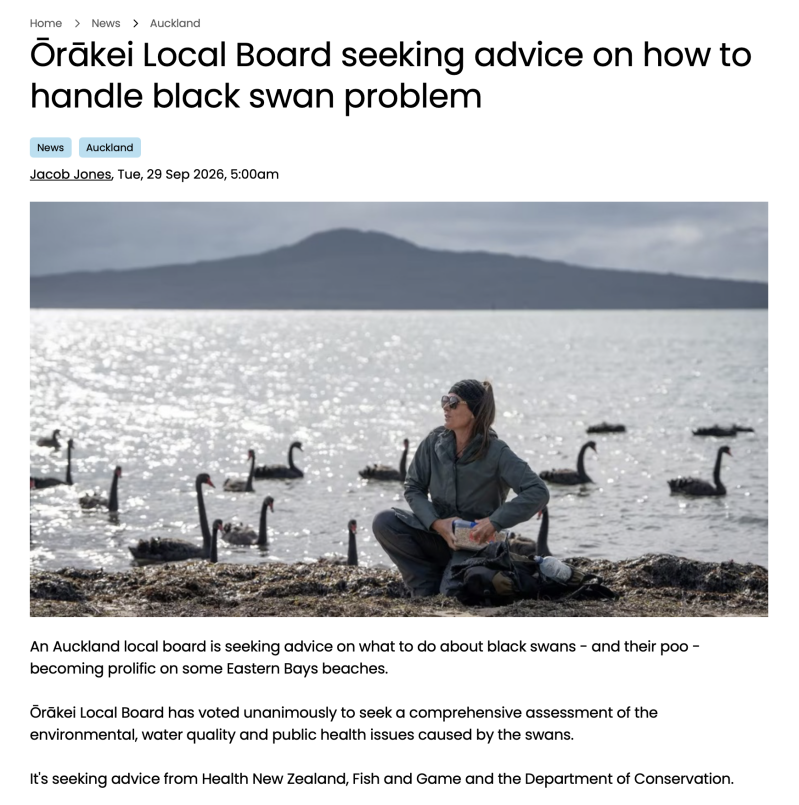
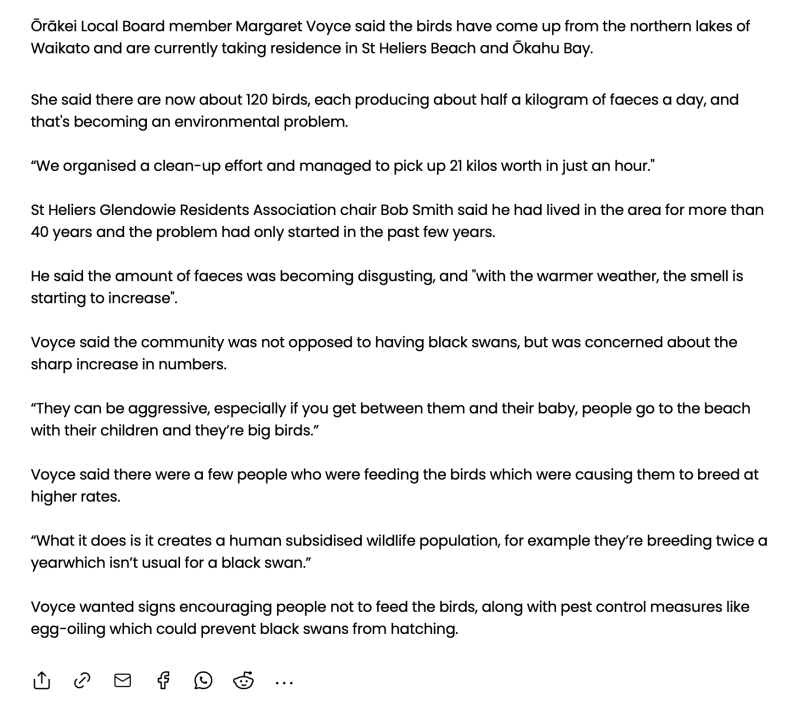
This article was then further released with increasingly sensationalised headlines through the NZ Herald and social media
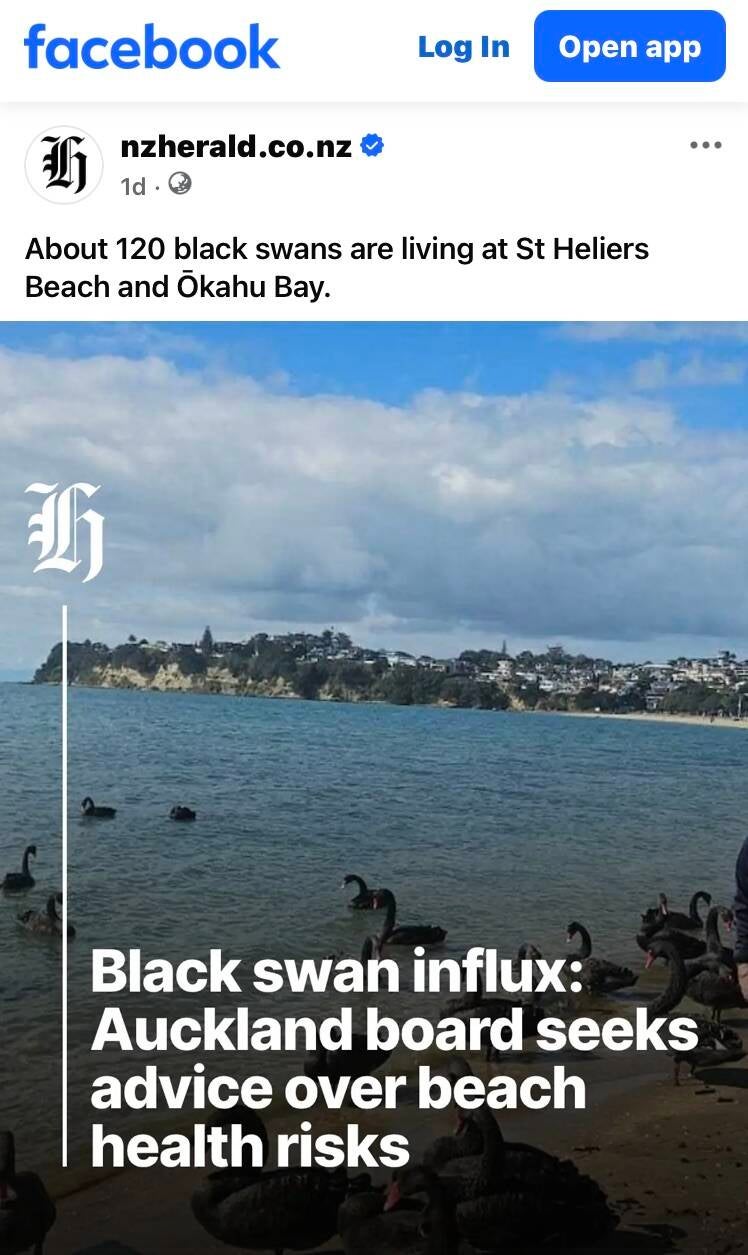
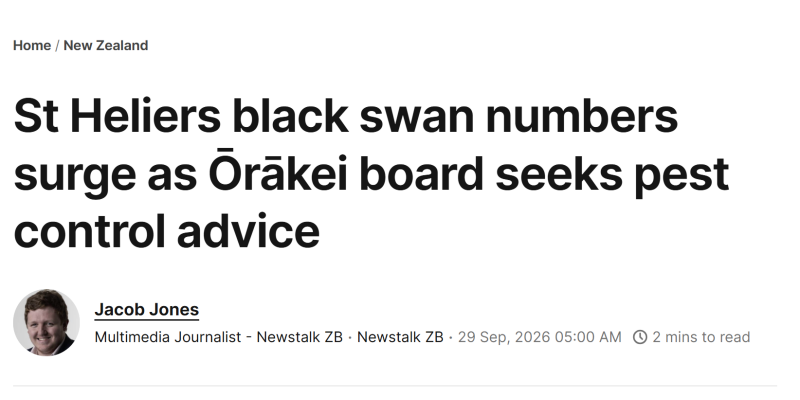
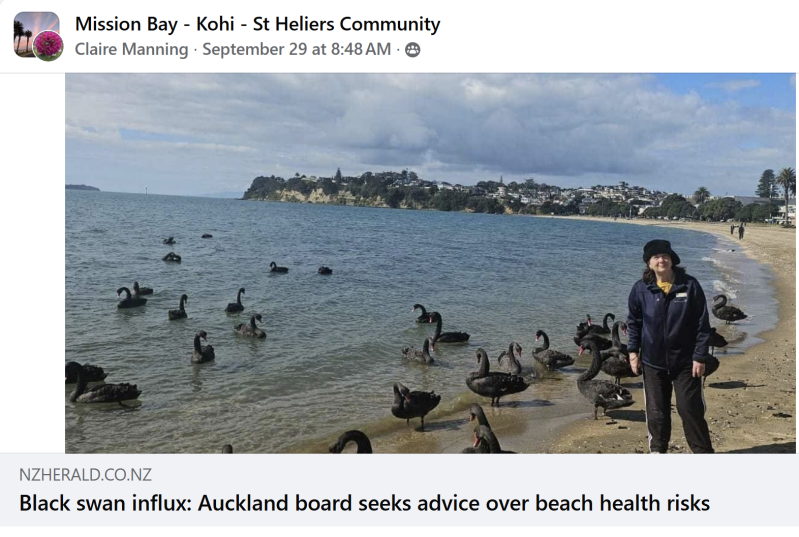
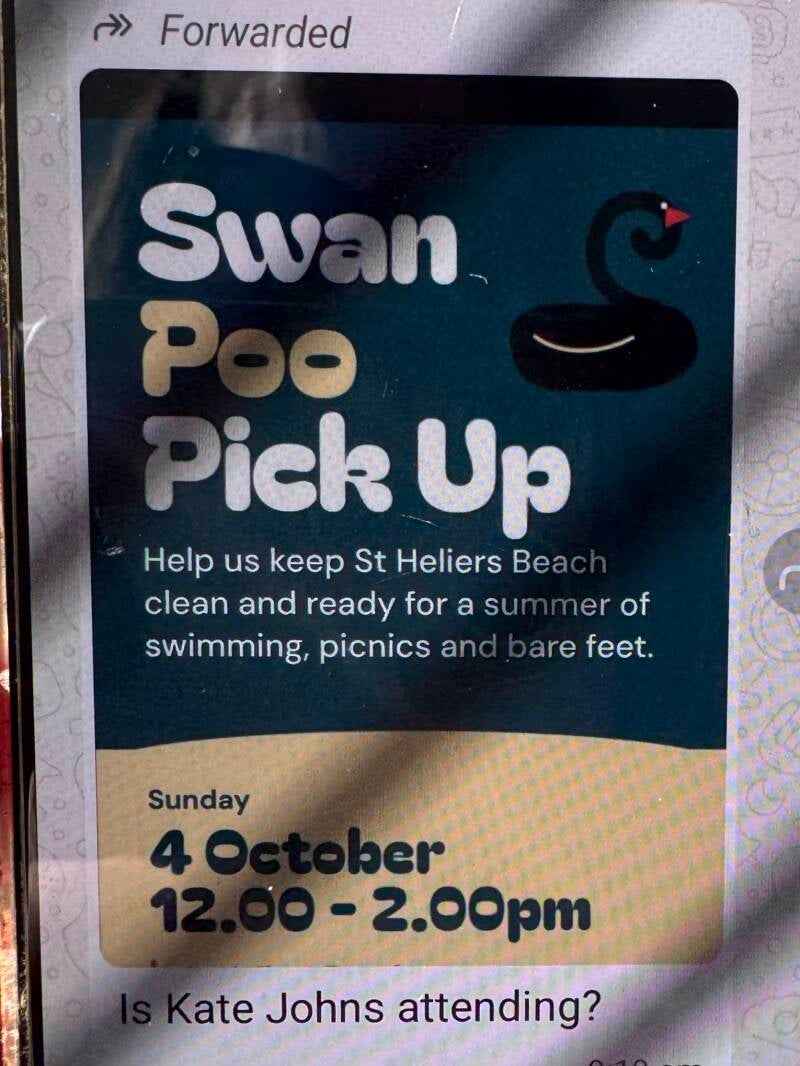
Other than the press release being a directly defamatory accusation, what Voyce has positioned is completely fabricated. As this site's purpose is to position actual facts and science, I will address each point she makes and show why her statements are politically-motivated fraud.
Below, I break down the lies that have been propagated and promoted, and the subsequent spike in animal abuse that has resulted, because a small group of locals don't like swans.
It's that simple. And it's provable.
As for "Swan poo pick up", "Is Kate Johns attending?" - uh, no. I have much better things to do than waste my time on nonsensical PR stunts.
False claim - ground zero
* "Orakei Local Board seeking advice on how to handle black swan problem."
* "Black swan influx: Auckland board seeks advice over beach health risks"
*"St Heliers black swan numbers surge as Orakei board seeks pest control advice"
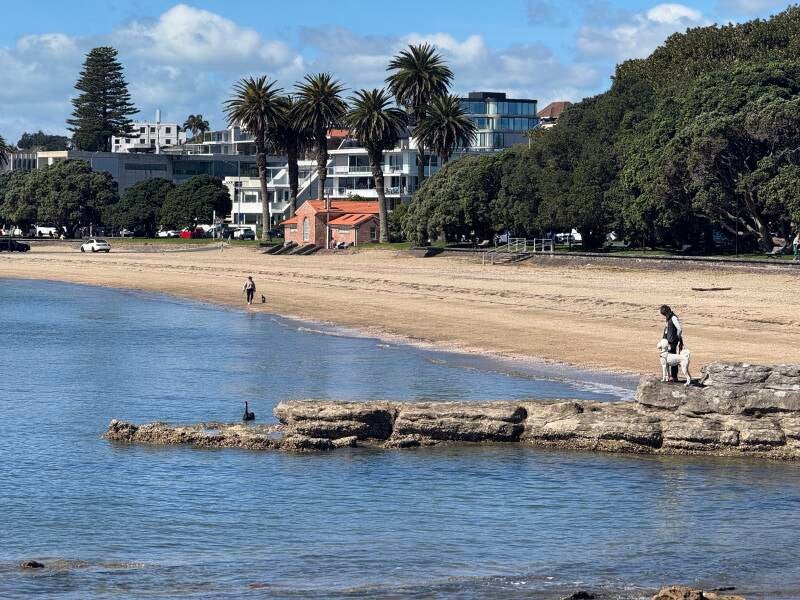
There is no black swan problem. There are small numbers of black swan intermittently using two very small areas of St Heliers Beach, a few hours maximum per day, in areas which are seldom used due to their proximity to the wastewater outflow pipes and the rocky foreshore. All of these claims were already asked and answered months before this press release, as per the following sections.
St Heliers, Auckland
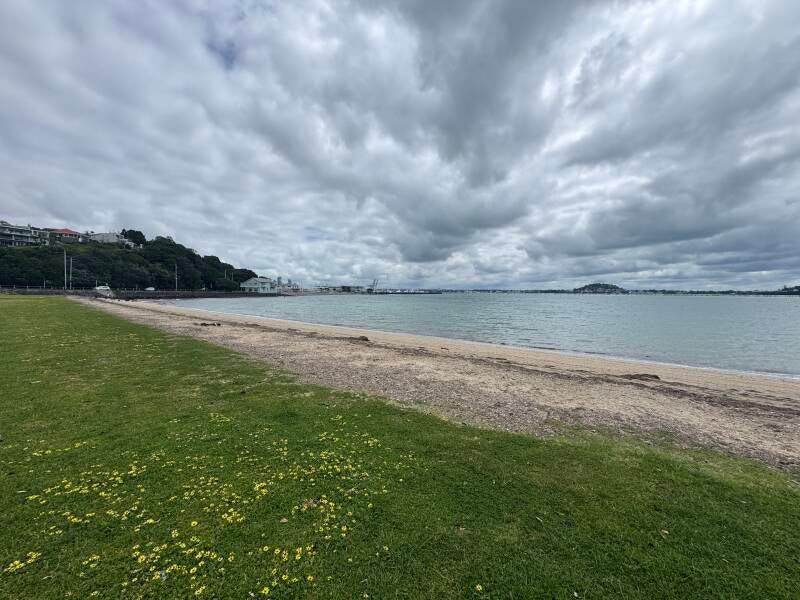
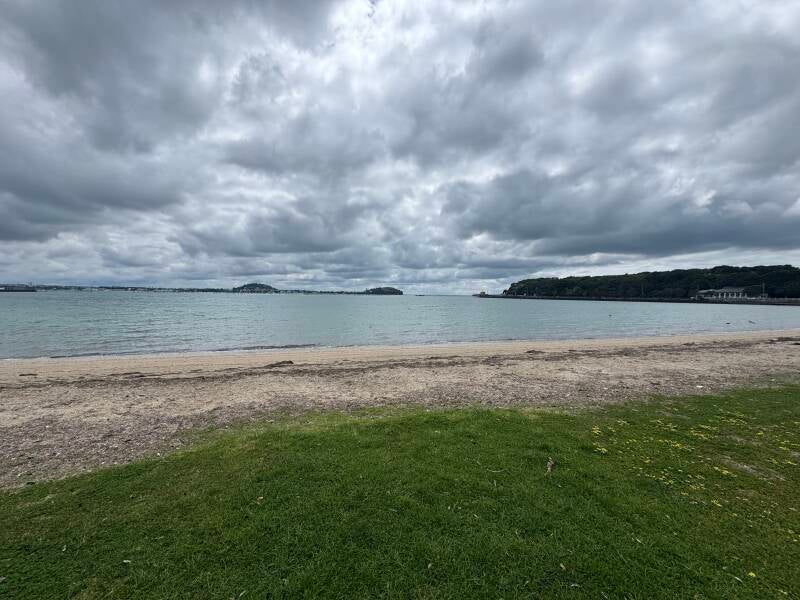
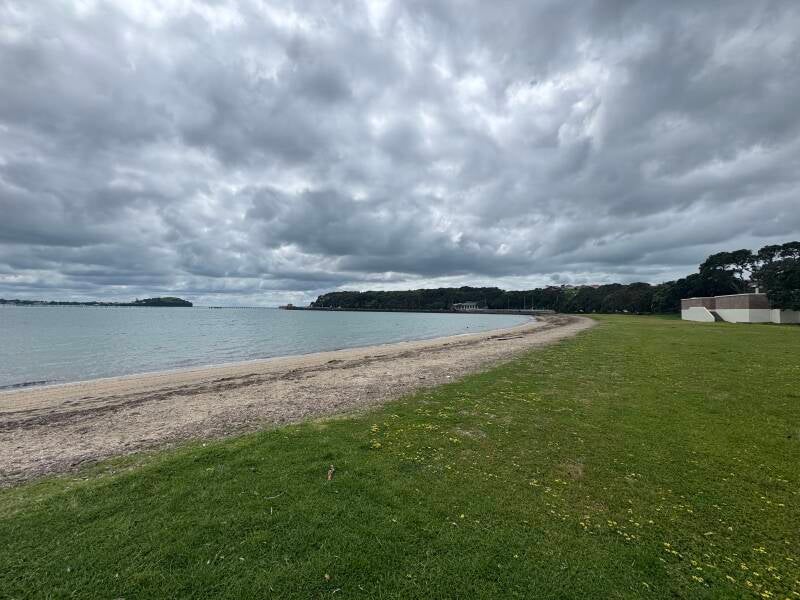
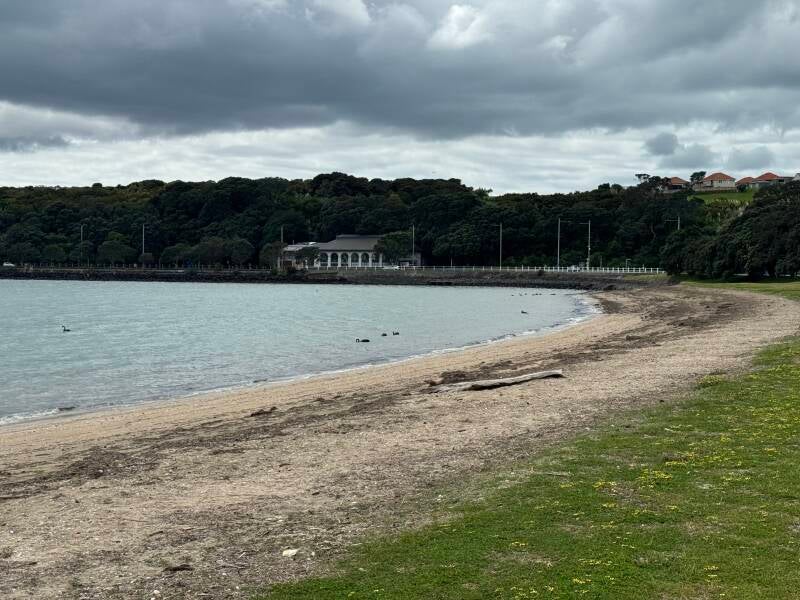
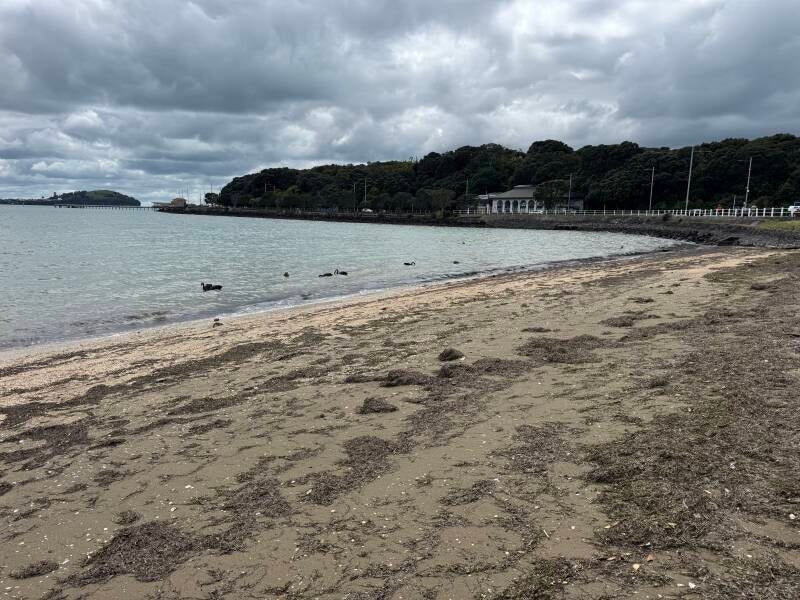
For those unfamiliar with this piece of coastline, it is worth knowing what this landscape looks like. From there the "scale" of this so-called "problem" is quite apparent.
The length of the coastline from Ladies Bay through to the junction of Long Drive is around 1km, with a sandy beach that runs about 700 metres long.
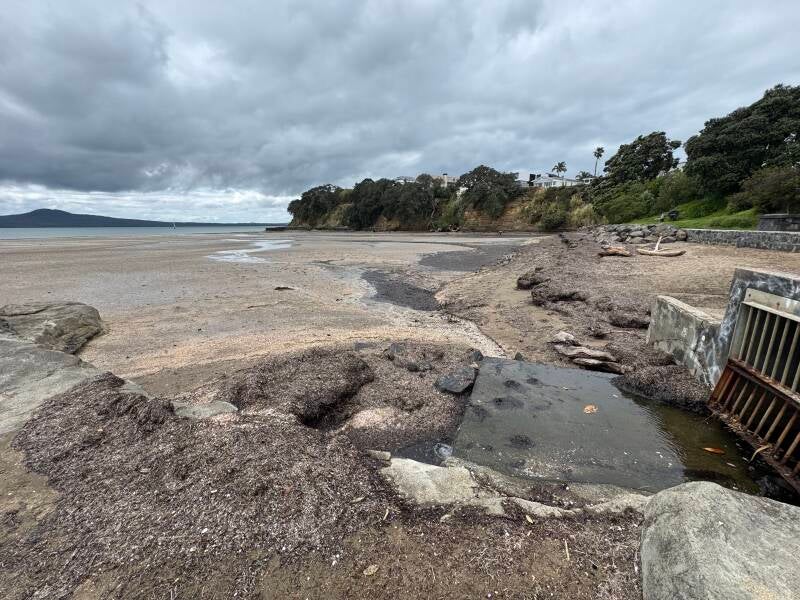
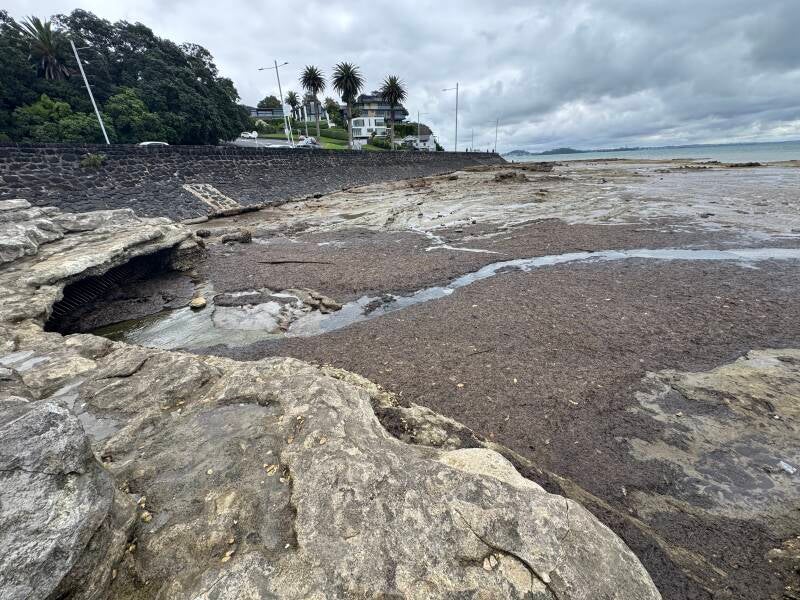
Beginning at the Southern end, you have an area that runs from the cliffs to a projection of rock; there are two wastewater pipes that exit into the ocean here and as such, this section is seldom populated. Beach debris usually collects here due to its 'flat' nature, as compared to the central sloped section where white sand was imported and the beach was built up.
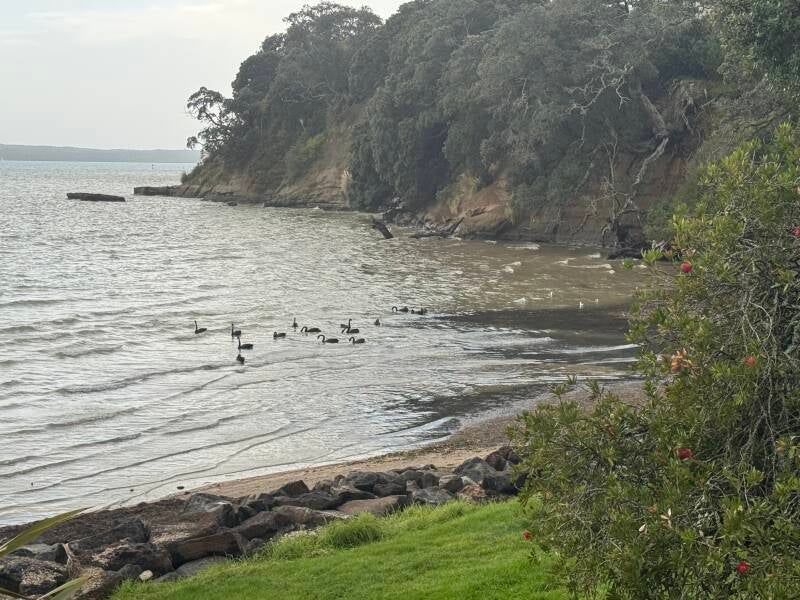
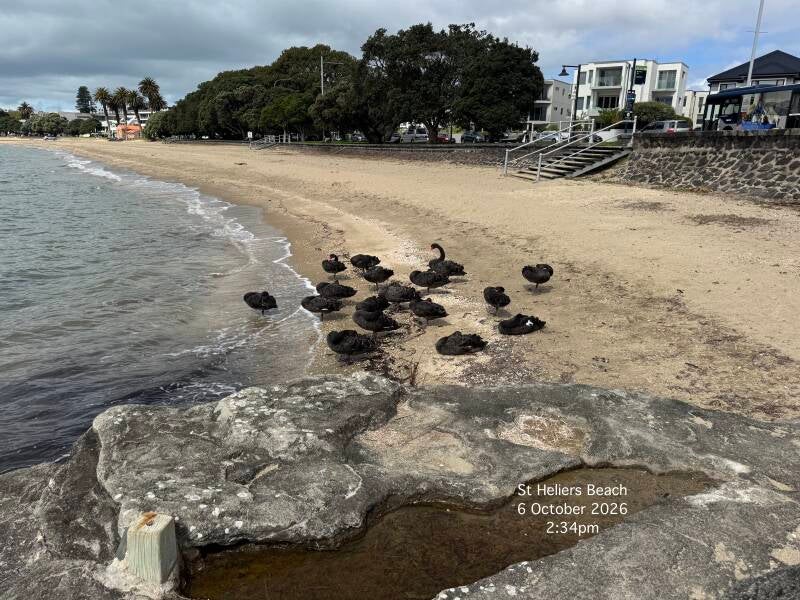
This is one of the two areas that the swans use; this one primarily when seeking shelter from the worst of the storms, as the cliff offers some protection from the worst of the winds, and the shallower water allows them to stand up rather than exhausting themselves out on the water. It also offers a geographical buffer zone away from people and dogs.
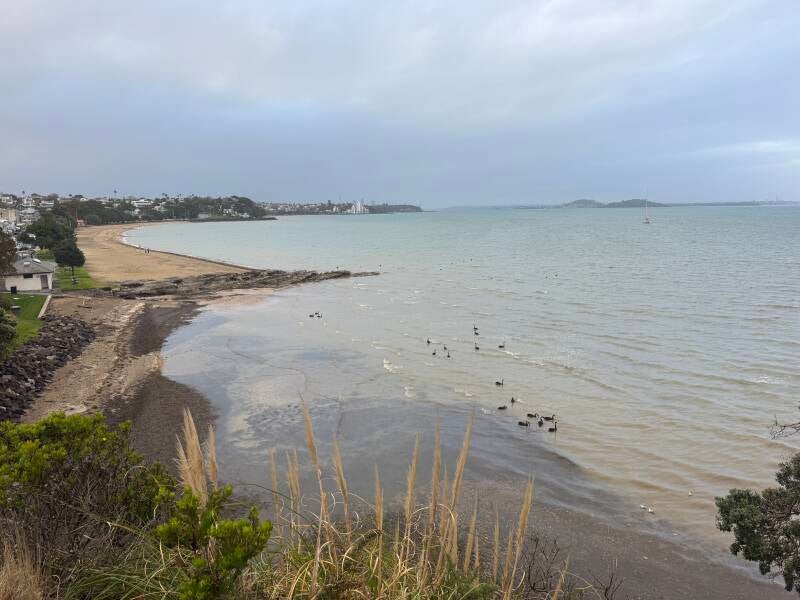
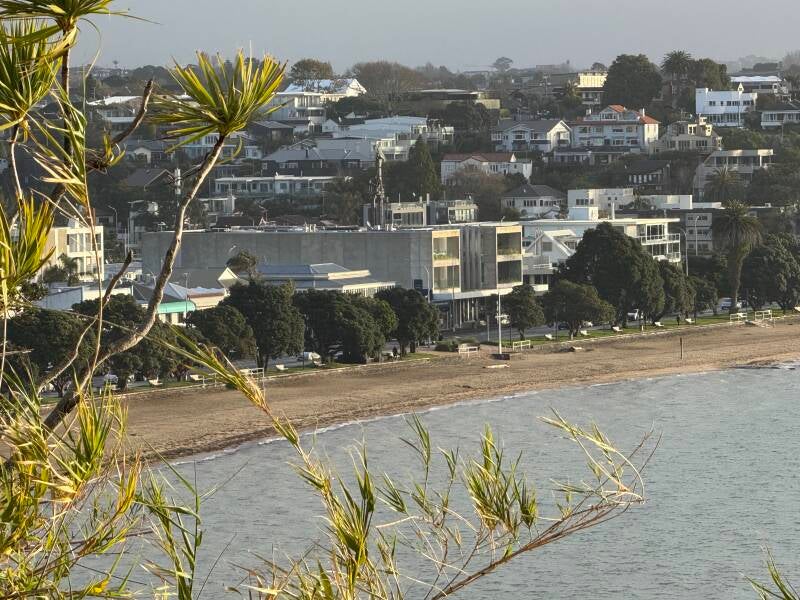
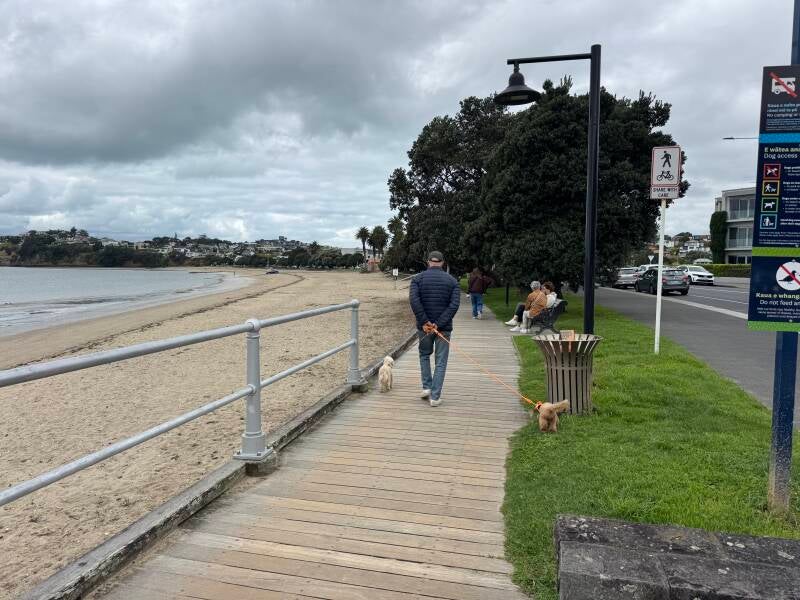
The central, and longest, section of the beach runs alongside the shops and main "people dominated" areas. This is the prime section of beach for swimming, water sports, boat launching, etc. There is a children's playground at the southern end, closest to Ladies Bay. I have never seen the swans 'come ashore' to rest here.

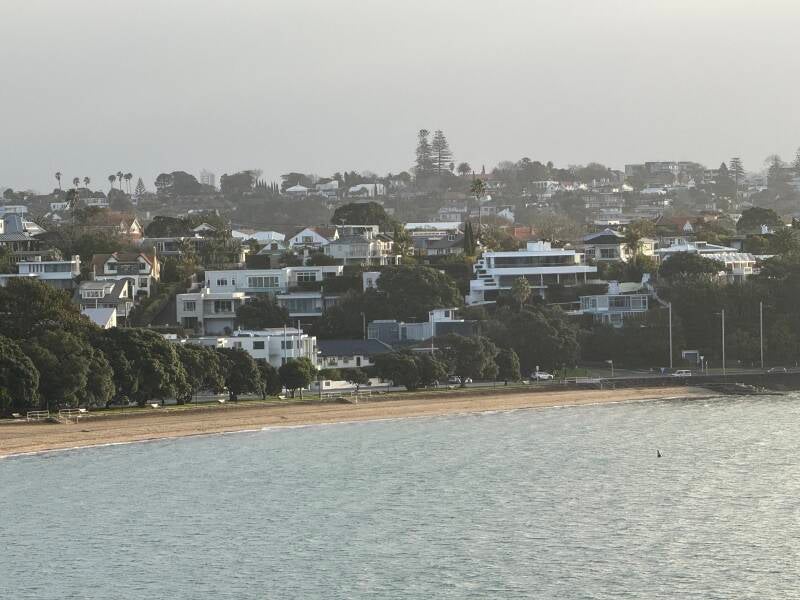
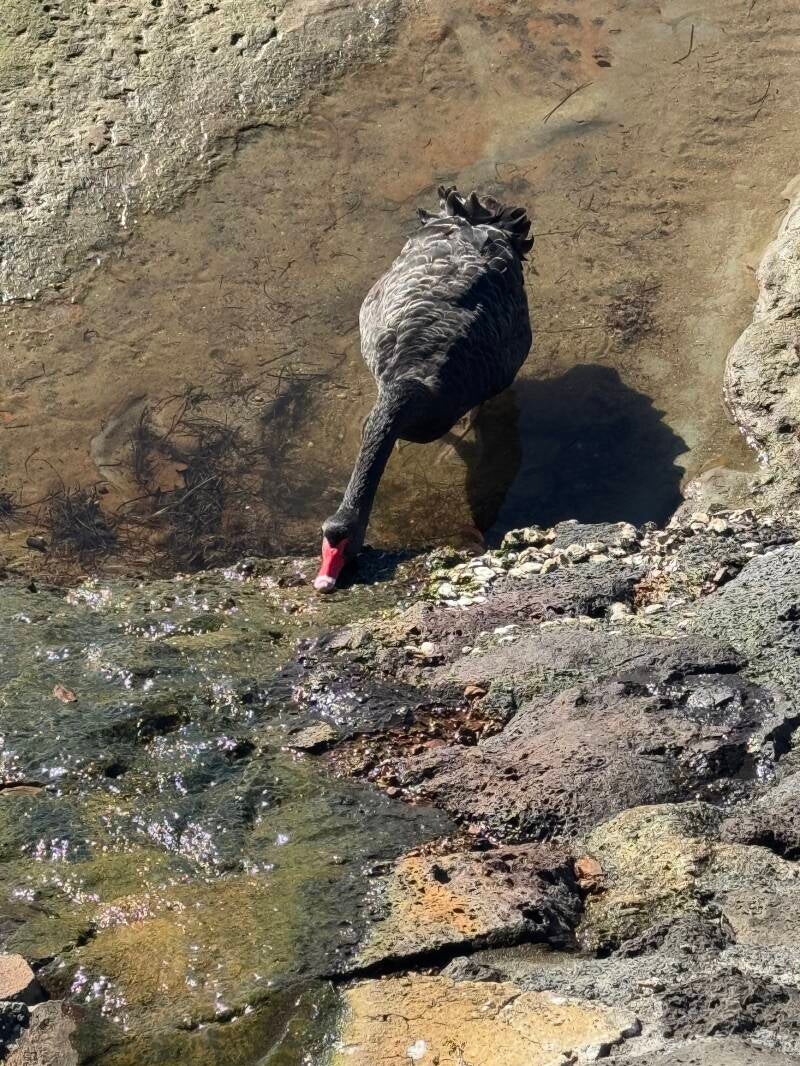
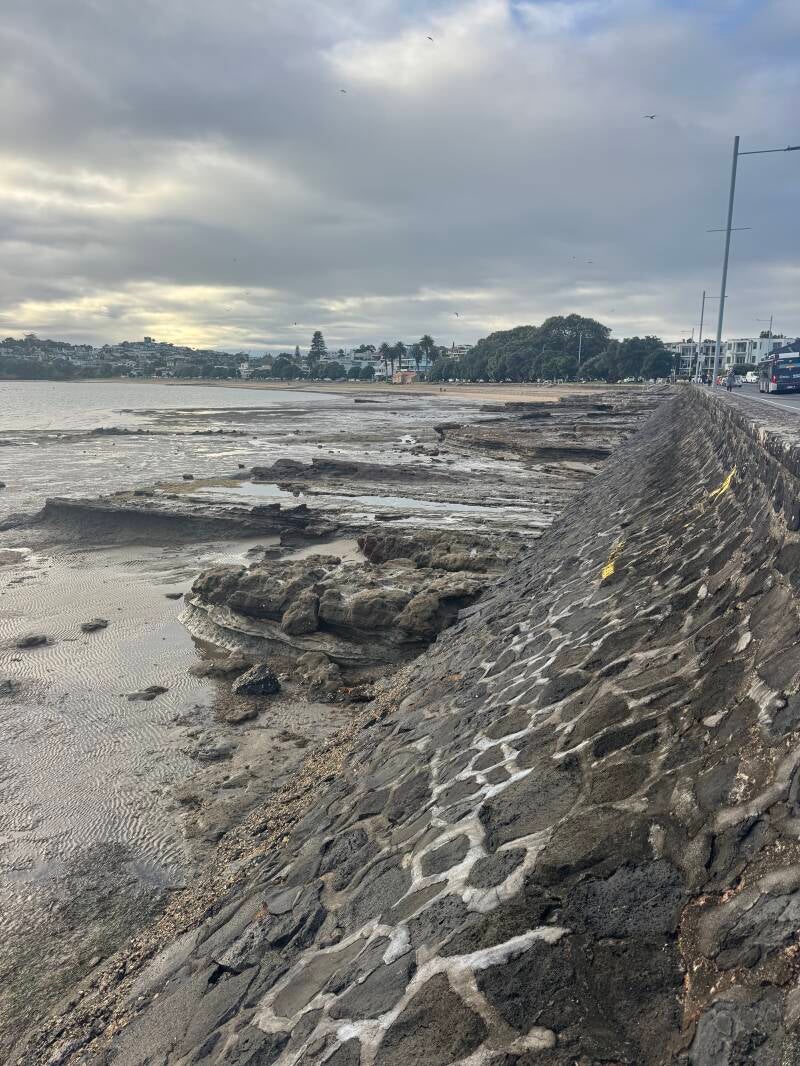
At the northern end there is again a projecting rock, which marks where wastewater pipes exit into the ocean, and then there is a rocky foreshore edged by a stone wall which runs through to the beginning of neighbouring Kohimarama Beach. There is a freshwater pipe that exits the stone wall above the raised rocky surfaces. Nobody swims at this end, nor do they use this rocky section for any other activities such as water sports.
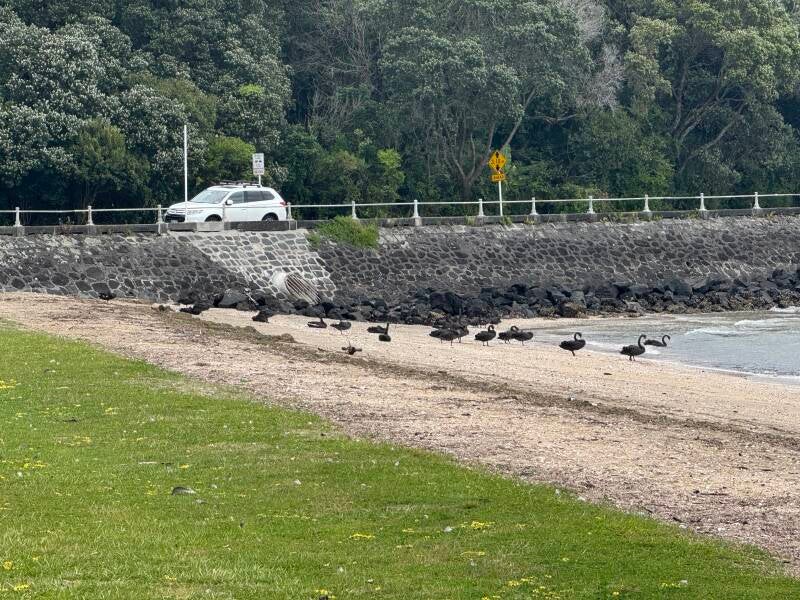
It is here - either at sea by the fresh water pipe access, or tucked into the shelter of the projecting rock - that you would find the swans.
Further down this page, under "False Claim 3" - you will see a slideshow with photos of the swans across time, located in these two areas. Notably, the swans proximity to the beach, and specifically these two areas, is only during high tide hours (approximately 3 hours, twice per day). As swans live on the tideline, when it goes out, so do they. For the other 18-odd hours per day, the swans will be found out at sea where they forage on the seagrass beds.
Okahu Bay, Auckland
Okahu Bay, which is also briefly referenced, is a 500 metre stretch of beach. At the city end there is a wastewater outflow pipe.
The total coastline between these two places is about 6km long, and includes Okahu Bay, Bastion Point, Mission Bay, Kohimarama and St Heliers Bay. There is over 3 kilometres of useable sandy beach for the general public. The swans use about 40 metres of that, for a few hours per day, almost exclusively within the wastewater and rocky shore zones not used by the general public.
False Claim 1 - "Seeking advice"
PRESS RELEASE: "An Auckland Local Board is seeking advice on what to do about black swans - and their poo - becoming prolific on some Eastern Bays beaches. Orakei Local Board has voted unanimously to seek a comprehensive assessment of the environmental, water quality and public health issues caused by the swans".
What is known: In July 2026, two months prior to this, the NZ Herald ran an article which included clear public, legal, and environmental refutations to these residents concerns, as follows:
Dr Imogen Bassett, head of the Council's Natural Environment Specialist Services, says swans are not causing an ecological issue and there are no current plans to control their population. "Even from a water quality perspective, the tide would be washing away their faeces, and water quality would not be affected."
Fauna Advice Manager for the Department of Conservation (DoC), John Lyall, also says DoC would not consider culling the swan population on the eastern suburb beaches.
Bassett points out that swan populations tend to fluctuate as the flocks move around. "Sometimes they can build up in numbers when conditions are favourable, and at other times can have significant population crashes, for example, if storms or other weather events damage their food sources."
Professor James Russell, who specialises in Conservation Biology at the University of Auckland, says decisions about culling need to be evidence-based. "When an animal is going to be killed, the evidence needs to be real. And there needs to be a high standard for the [evidence]." The wider community would also need to be consulted before culling was considered, he says. "Does everyone think that, or is there a large sector of the community that think 'no, it's beautiful that these large, gracious birds are now gracing our beaches and I'm more than willing to accept a bit of poo for that'?"
Russell says accusing swans of taking food from other seabirds can be a form of "scapegoating". Those who care deeply about seabirds should probably start concentrating on ways to solve climate change - "how much we drive our fancy cars and take our fancy holidays" - and overfishing, he says. "Even if the swans were taking some of their food, they're all fighting over such a diminished, collapsed ecosystem so we should probably be turning that finger back at ourselves."
John Dyer, a retired wildlife officer with Fish & Game, agrees the collapse of water quality in lakes and ponds in the North Island has driven swans to search for food sources in harbours and at beaches.
Studies have repeatedly shown that swan faeces had little effect on fresh-water quality. Eutrophication is more likely caused by farm run-off and pollutants like septic tanks.
David Klee, Chief Executive of Fish & Game in the Auckland and Waikato region, agrees, saying the collapse of lakes like Whangape and Waikare in Waikato meant thousands of swans - herbivores that eat submerged water plants like seagrass (zostera) - have to search elsewhere for food. The irony, he says, is that after years of pollutants running into the Manukau, the harbour had been cleaned up, which has attracted the swans back to a food source. "If there is food, they will come, basically."
Swans fall under the Wildlife Act 1953, designated as native but can be hunted [under license]. Although they have adapted to seawater, thanks to salt glands above their eyes that help to excrete excess salt through their nostrils, they still need fresh water to drink.
What is known: About one month prior to the press release, in direct response to continued local anti-swan positioning to add swans to the pest species management plans—Auckland Council’s Pest Free team issued this:
"The definitive answer from my colleagues in Biosecurity is that black swans are not a species Auckland Council is currently prioritising the control of because they are not classified as a pest in Auckland’s Regional Pest Management Plan (RPMP), and they remain legally protected under Schedule 1 of the Wildlife Act 1953 as a legal gamebird species in most parts of New Zealand. They are managed by Fish and Game New Zealand."
"Also, although large numbers of black swans may have some limited impact on water quality and avian influenza risk, black swans are not considered a major pressure on the regionally significant species and ecosystems. They do occasionally eat from zostera (seagrass) beds, but this is not their preferred food source (they prefer freshwater vegetation)."
Yet, despite these explicit, definitive statements, Margaret Voyce has actively continued to advance and perpetuate the alarmist narrative. She has pursued this political trajectory in direct defiance of clear public, legal, and environmental refutations issued by the Department of Conservation (DOC), Fish & Game New Zealand, a University of Auckland Ecological Specialist, and Auckland Council’s own Pest Free Biosecurity Agency and Natural Environment Specialist Services.
This systematic refusal by Voyce, and the Orakei Local Board, to acknowledge established consensus from the country's primary conservation and health authorities underscores a deliberate intent to sustain public panic and maintain political pressure irrespective of the factual record.
In light of this, the subsequent Orakei Local Board Motion, put forward by member Margaret Voyce, seeking to obtain formal agency advice regarding the swan population is completely disingenuous. Comprehensive, advisory determinations had already been directly provided by the relevant conservation and biosecurity experts - including two within it's own agency.
The ongoing deployment of the campaign is not a result of a lack of available scientific or structural information, but rather a total, systemic refusal by political actors to accept information when it fails to support their desired culling and pest narrative.
false claim 2 - up from the northern lakes of waikato
There are no agencies who track the local Auckland swan populations, outside of those in Manukau Harbour and Northern Auckland/Northland which are tracked by Fish & Game. The swans in St Heliers could be coming from, and going to, many places.
What we do know: "Presently, black swan in the Northland, Waikato and Rotorua regions are believed to be one highly mobile meta-population, which shifts about these three regions in response to food availability" (M Williams, Victoria University, pers. comm)
What we do know: "the collapse of water quality in lakes and ponds in the North Island has driven swans to search for food sources in harbours and at beaches." - John Dyer, retired wildlife officer with Fish & Game, NZ Herald, July 2026
What we do know: Auckland experienced spikes locally a few times in 2025, before swan numbers again returned to baseline, suggesting that as a whole swans are transitioning through Auckland before then dispersing across the wider North Island regions.
What we do know: A Waikato displacement event drove swans out of the Waikato lakes. "The collapse of lakes like Whangape and Waikare in Waikato meant thousands of swans - herbivores that eat submerged water plants like seagrass (zostera) - have to search elsewhere for food. The irony, he says, is that after years of pollutants running into the Manukau, the harbour had been cleaned up, which has attracted the swans back to a food source. "If there is food, they will come, basically." - David Klee, Chief Executive of Fish & Game in the Auckland and Waikato region, NZ Herald, July 2026
What we do know: Following the Auckland Airport culls in early 2026, there was further displacement. In the weeks following the culls, four separate groups arrived from the direction of the Manukau Harbour, temporarily staying at Tahuna Torea Bird Reserve, before largely dispersing again over the following months. As culls are timed with moult season, it is possible that Tahuna Torea offered a sanctuary while they recovered/regrew their flight feathers.
What we do know: Every year there is a migration event that takes place between the Kaipara Harbour in Northland and Manukau Heads in Auckland. These migrations are tracked by Fish and Game. Manukau Heads is an annual moult site. They come, they moult, they return to the Kaipara Harbour.
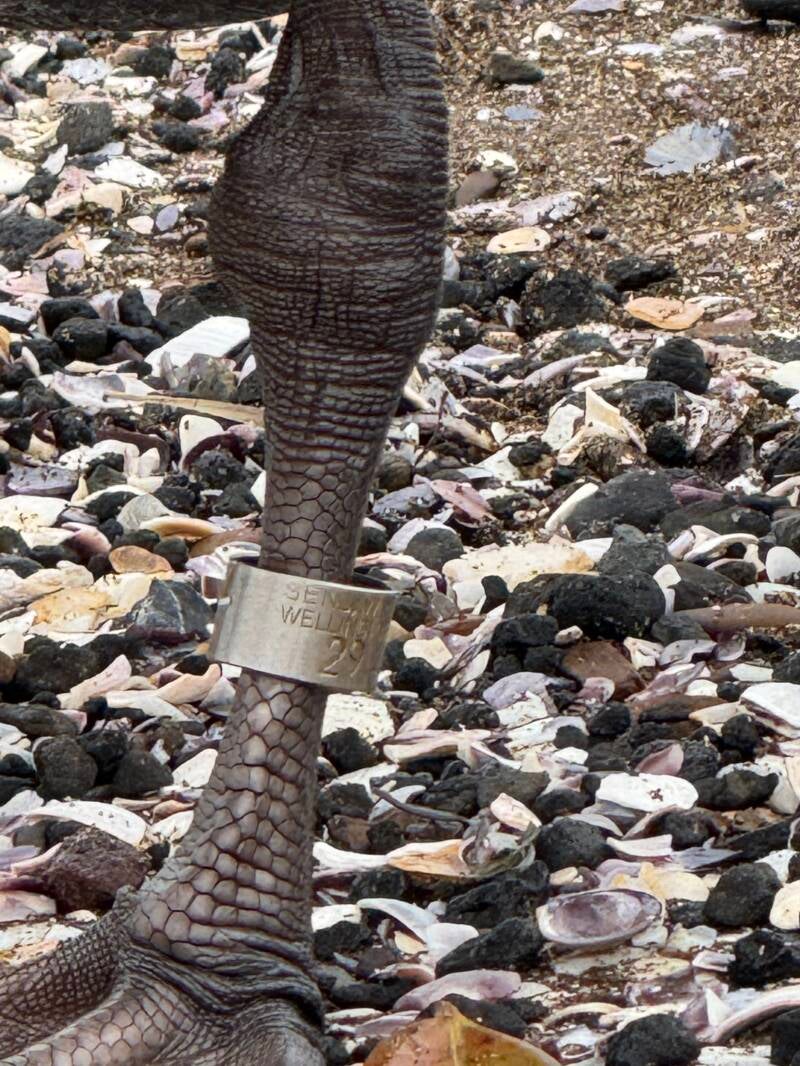
What we do know: About two months ago, a banded swan arrived at Tahuna Torea. His band read "Wellington". The below photos were taken on the 16th September 2026.
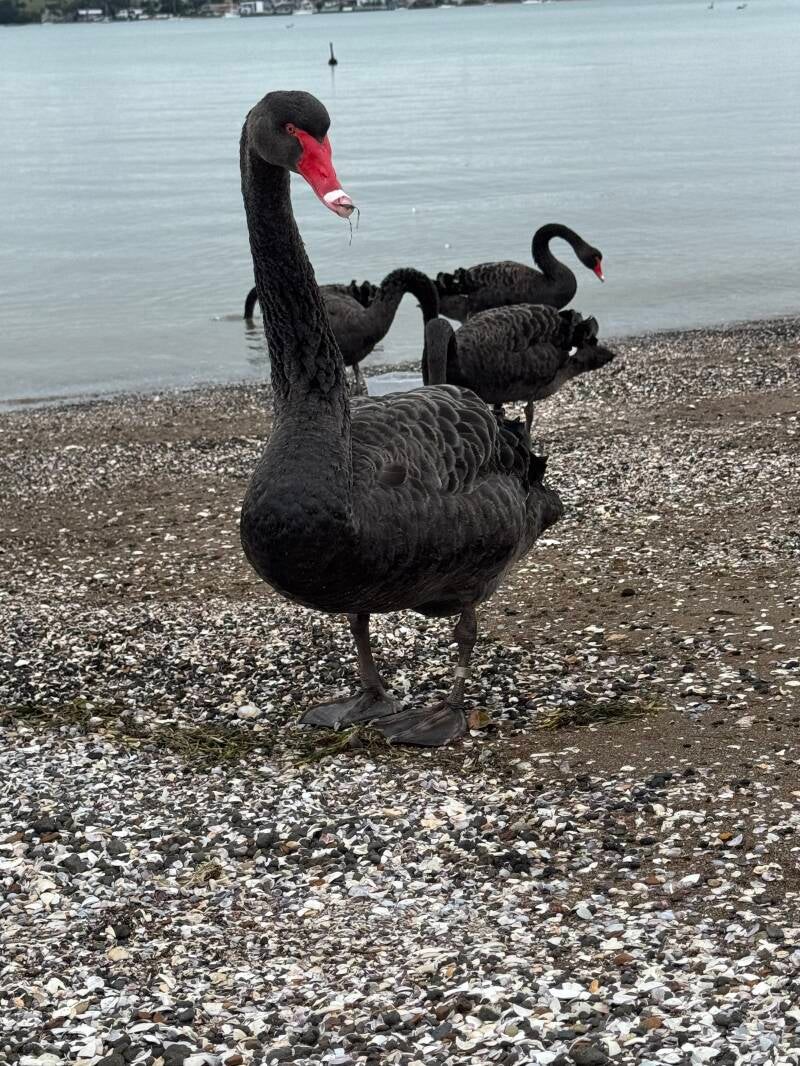
What has been confirmed:
On August 26th 2026, I personally contacted Fish & Game for the Auckland Region to clarify the official data held.
I wrote:
"I have been working with the swans for the past few years, including in their rescue, recoveries and generally documenting them in my local area.
I have been doing so under the ongoing assistance and advisement of two wildlife vets, WRRENZ and a few NZ wild bird experts. I have also been in touch with some swan-specific experts internationally. The information on black swans however seems to be very limited given their native status in NZ, such as in regards to migration and population trends/statistics (I can't find anything on Auckland at all), ecological interactions or observations, behavioural science, scientific research other than some studies done in the 1960's/1970's.
What I was hoping to discuss were the gaps in this knowledge, and what Fish and Game holds in these areas. My presumption is that if Fish and Game are in control of (?) population management, then there must be data that they are basing that management on. Based on the sparse general information I have been able to find, the population today across NZ is estimated to be approximately the same as it was 50 years ago - sitting at around 50,000 - with Fish and Game annual hunting rates at about 5000 per year. Does this sound about right?
About a year ago [2025] I received information that was made available by a Waikato based Ecologist who had shared that the black swans had been leaving the Waikato en masse due specifically to significant environmental degradation of their habitats. In effect, they could no longer survive where they were and so had no choice but to leave. In effect, this was not a natural migration pattern, nor would the conditions in the Waikato allow a return to those habitats. This tallies with a population surge we witnessed in Auckland across spring of last year. By summer the local numbers had again dropped, suggesting that these Waikato swans had dispersed further afield - perhaps north or east?
I am particularly interested in the swan numbers and health in Auckland, and the factors related to this. For example, generic information is often posted stating that all birds had sufficient natural resources for survival. However, my experience and the corresponding veterinary observations and diagnostics consistently show severe malnutrition and dehydration levels for black swans both in the ocean and within our local unmonitored small freshwater ponds. What has been observed is that in both habitats, access to freshwater and sufficient food is severely lacking and resulting in significant death rates (especially in those under 1 year), egg failure rates, and notably poor body condition scores. This month alone we have had three back to back deaths of juveniles of approximately 6 months of age, all from what appears to be due to the above factors. We have also had only 2 cygnets survive (currently around 5 months old) across four nests. Assuming the average eggs per nest is 6, that is 2 out of 24 - an 8% survival rate. This is a significant drop and does not support the 'sufficient resources for survival' position. The resources they need are very different from those of say, forest birds, where great effort has been put into planting ongoing food sources, or omnivorous birds who have a greater range of food available to them.
Linked to this is the ways in which the environment allows or prevents access to resources. As swans have to access food within reach, by necessity they must get to relatively shallow water. Locally, for ocean living swans, this tends to be near the tide line where predation threats are at their highest - dogs, people, etc. I can only speak to my experiences here, but my observations and what I have consistently reported to government agencies, has been that those who don't like swans have been consistently and intentionally forcing them back into the ocean when they try to come on land to access water, food (ie grass) or to rest, preen, waterproof etc. As a result, and again consistently reported and documented near me, those in most need of these resources have succumbed to death from severe dehydration and/or starvation.
So - this circles back to the above. On the one hand the assertion that resources are 'theoretically' plentiful and readily available, on the other hand the reality which is a consistently high death rate, especially in the just-fledged age group; a local death rate in cygnets of 92%; consistent confirmatory diagnostics of severe malnutrition and dehydration; and consistent observation and reporting of intentional prevention of access to resources by the public resulting in further deaths from the same. It is hard to see how these two positions can co-exist.
This is one of the reasons why I am seeking data for the Auckland area. It could be, for example, that abundant natural resources are available in areas where the black swans are in large freshwater bodies, or in areas that are highly maintained such as Western Springs, or in particular cities where public sentiment/behaviour is such that it does not interfere with access to resources.
Generally speaking, I am interested in any information beyond the above which would be available for educational or informational purposes -
The information on black swans however seems to be very limited given their native status in NZ, such as in regards to migration and population trends/statistics (I can't find anything on Auckland at all), ecological interactions or observations, behavioural science, scientific research other than some studies done in the 1960's/1970's. "
Response from Fish and Game, 27th August 2026
"Much of the recent Auckland/Waikato Fish & Game monitoring information we have on black swan population indices and harvest is detailed in these two publicly available reports:
- https://www.fishandgame.org.nz/assets/DMS/About-us/FG-Regional-Councils/Auckland-Waikato/Staff-Reports/Game-Reports/2024-2025/Trend-Count-Report-2025.pdf
- https://www.fishandgame.org.nz/assets/DMS/About-us/FG-Regional-Councils/Auckland-Waikato/Staff-Reports/Game-Reports/2025-2026/Harvest-Report-2025_2026.pdf
These reports represent the main information we are able to provide in relation to your questions. We don't have sufficiently detailed monitoring data for Auckland specifically to comment on the localised population trends, movements, survival rates or causes of mortality you describe. "
false claim 3: "120 birds", "becoming prolific", "sharp spike"
There have never been 120 swans at St Heliers. They are not "becoming prolific". There has not been a "sharp spike".
What is known: eBird offical counts have put the maximum number recorded across the past two years at St Heliers at 35 swans.
As with all wildlife, visits vary over time, and can increase during storms when animals need to seek sheltered bays. As swans can only feed up to one metre below the surface (in good weather), they are often unable to access food during storms, so the day after it is not unusual to find them returning to areas of known food sources - in the case of St Heliers and Kohimarama beaches, these are the locations of Zostera (seagrass) beds - and, critically, fresh water.
There is a fresh water pipe in the rock wall at the far end of St Heliers. When the swans can access the fresh water, they organise in groups, with older juveniles and adults leading the younger swans to the water source. For a few hours per day, when the tide is just right, and weather conditions allow, the swans can get to this area. Without fresh water, black swans die. They are not seabirds, so can only tolerate a certain amount of sea water through the use of a gland in their brain which helps them to excrete the excess salt.
What is known: I have compiled a slideshow below of the swans at St Heliers from every visit I took there across the period June to October of this year (2026) - at the height of the rhetoric. I have put the time, date and location on each photo as well as noting when there were significant storm conditions, which are easily verifiable on any weather database. [Even in these events, the numbers don't come near to the numbers claimed by Voyce.]
What is evident from these photos and documentation is that there is not, nor has there ever been a "resident population" of 120 swans at St Heliers. In fact, even when adding together the swans along the whole coastline from Okahu Bay to St Heliers, there are not 120 swans, making this claim completely disingenuous and deliberately provocative.
What you will also notice in this slideshow is:
- no environmental crisis
- sandy areas not covered in swan poo, let along 22kg piles of swan poo
- no swans 'acting aggressively' or approaching people, but to the contrary people actively heading TOWARDS the swans to enjoy them
- no eggs needing oiling, or nests
- no cygnets
- swans almost exclusively occupying only small areas at either end of the beach near the wastewater pipes and rocky foreshore
- children and families happily playing or lying or walking in the sand near the swans
and most notably,
- very long stretches of beach that the public exclusively is using where there are no swans


What is known: The below graph, from eBird, shows the official 'average count' of black swans in St Heliers Beach - specifically - through 2025 and 2026.
Again, in line with a "highly mobile meta-population, which shifts about these three regions in response to food availability" - as confirmed by the literature and experts.
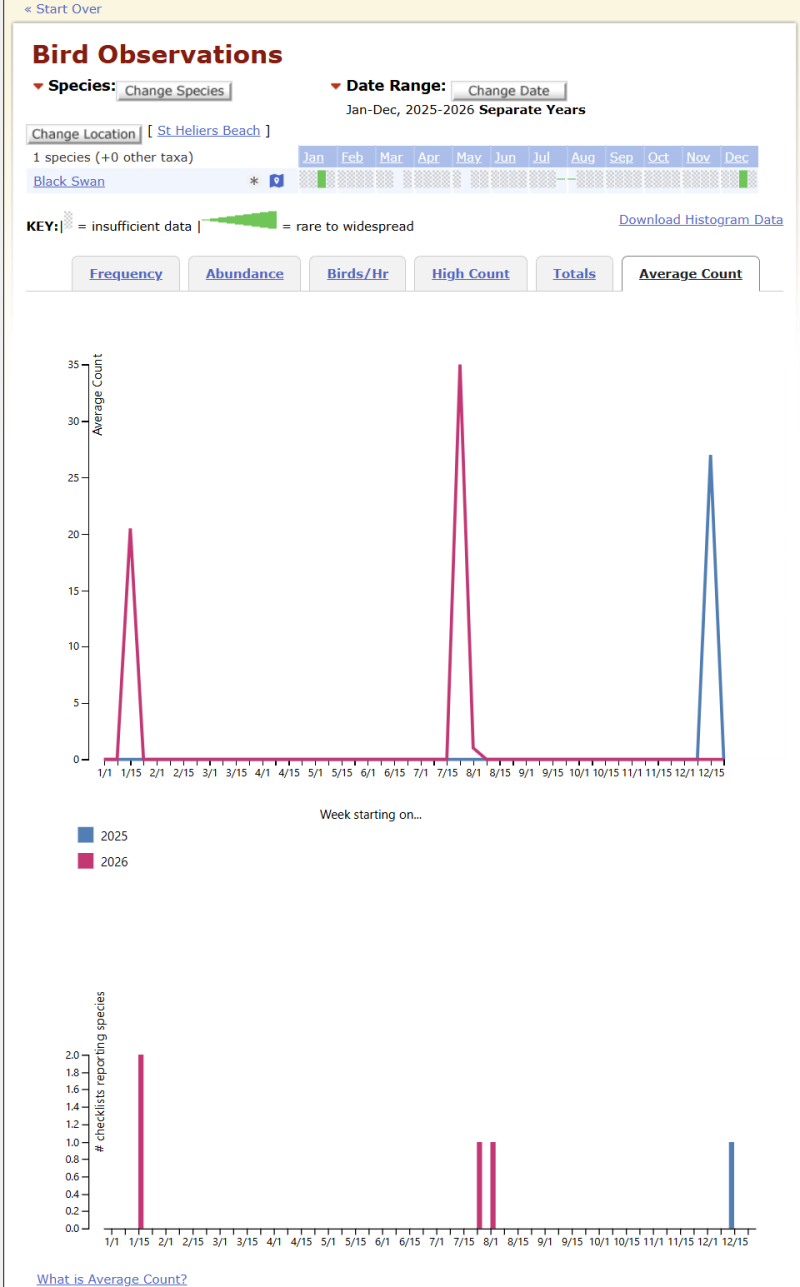
The raw data breaks down as follows:
- 15 December 2025, there were 27 swans.
- 15 January 2026, there were 35 swans.
- 20 January 2026, there were 6 swans.
- 21 March 2026, there were 49 other birds, ZERO SWANS.
- 14 May 2026, there were 33 other birds, ZERO SWANS.
- 24 July 2026, there was only 1 Caspian Tern recorded.
- 30 July 2026, there were 35 swans.
- 2 August 2026, there was 1 Common Myna and 1 Black Swan recorded.
- 22 October 2026, a local confirmed 12 swans.
What is known: The below graph, from eBird, shows the official average counts at the nearby Tahuna Torea bird sanctuary, over a four year period, offered for context.
As can be seen in this chart, the numbers go up, down, up, down, up, down. Never static, and completely in line with a "highly mobile meta-population, which shifts about these three regions in response to food availability" - as confirmed by the literature and experts.

What is known: Official eBird data counts over the past few years show several sudden increases in the Tamaki Estuary populations followed by equally sudden drops within months - below is a clear example of their variability, in a random sample taken roughly every three months.
- In January 2025, there was a count of 500 swans. (In line with the Waikato displacement event)
- On 7 March 2025, there was a count of only 2 swans.
- On 1 June 2025, there were 40.
- On 20 September 2025, there were 136 swans. (in line with moult season)
- On 29 January 2026, there were 40 swans.
- On 14 March 2026, they were 70.
- On 15 June 2026, there were 33.
- On 4 September 2026, there were 251. (Swans currently in moult season - as per photos below)
- On 2 October, there were 80 recorded.
This data is not indicative of a 'permanent' or 'resident' population. It is indicative of a transitional movement pattern.
Population Trends
What is known: At the standard seasonal peak window for September 2026, the highest single-day count recorded at Tahuna Torea had dropped to 300 individuals, with general high-flock averages hovering around 250 birds, compared to the last logged single-day population count at St Heliers Beach of just ONE individual swan, recorded on 2 August 2026.
When comparing the true baseline of the influx across the entire Eastern Suburbs coastline and Tamaki Estuary (>500 birds in Jan 2025) to the absolute peak of the current population (250–300 birds in Sept 2026), the local swan population has actually declined by 40% to 50%.*
*As of October, this same population decreased even more, to around 150 swans, followed weeks later by an official count recorded of 80 swans, with no increase in St Heliers counts. This is a 70% decrease from the January 2025 baseline.
What is known: Long-term multi-year trends indicate that northern swan populations are highly volatile and under environmental stress. This is supported by Fish and Games’ own reports showing that black swan populations have been trending downward for the past 20 or so years.
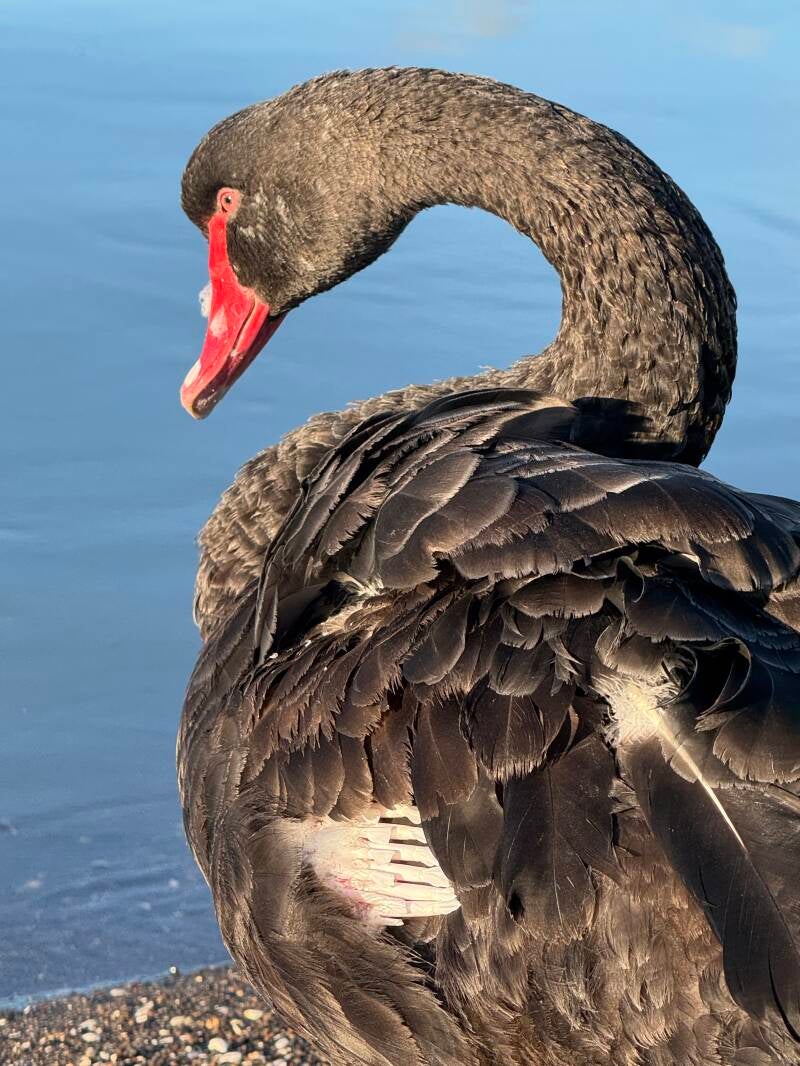
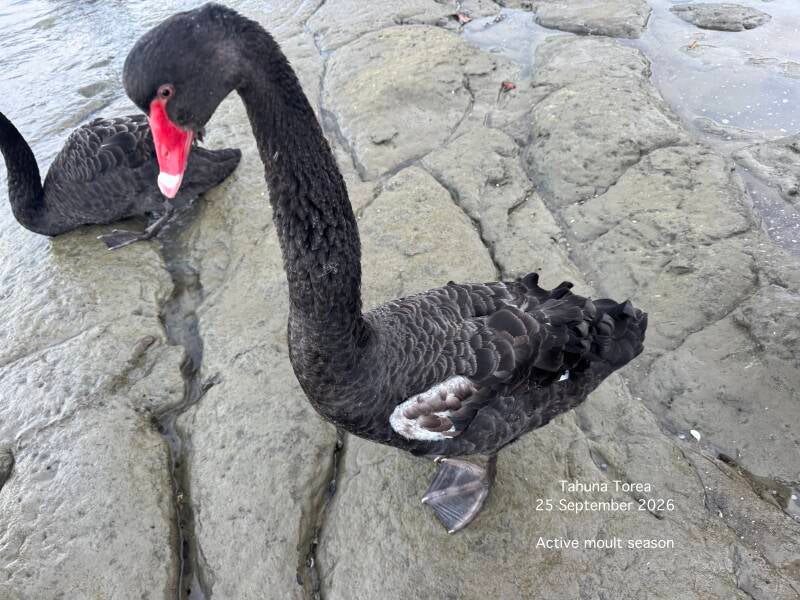
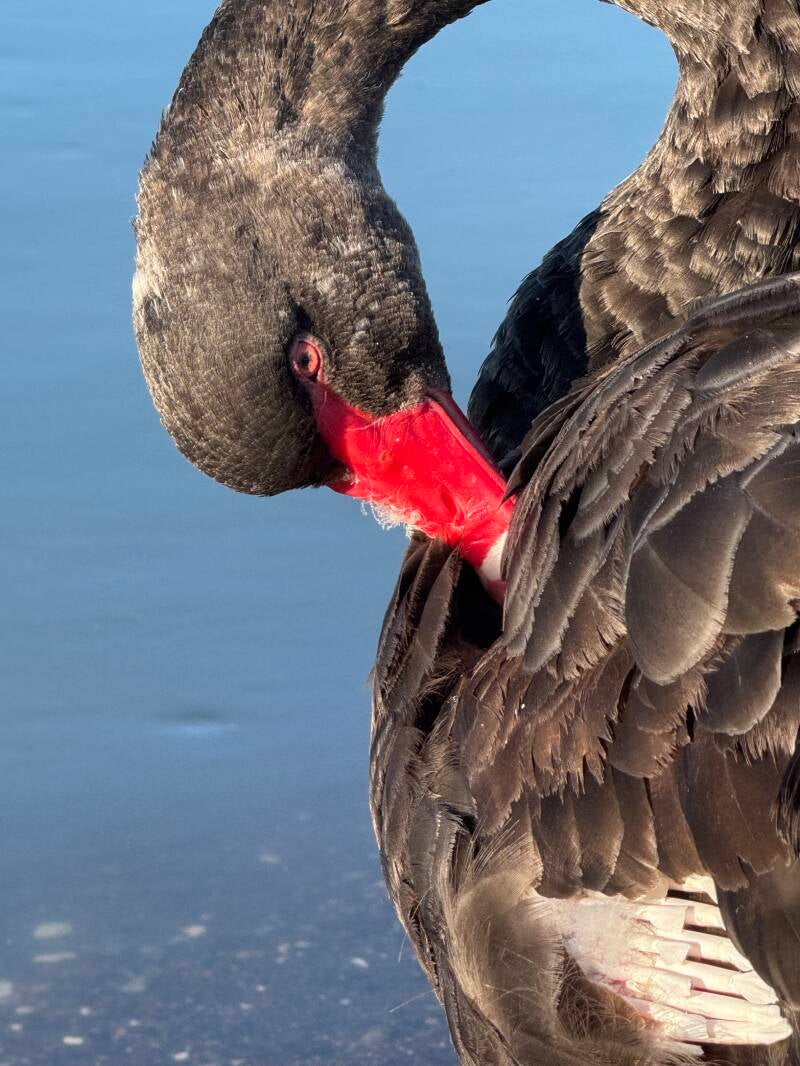
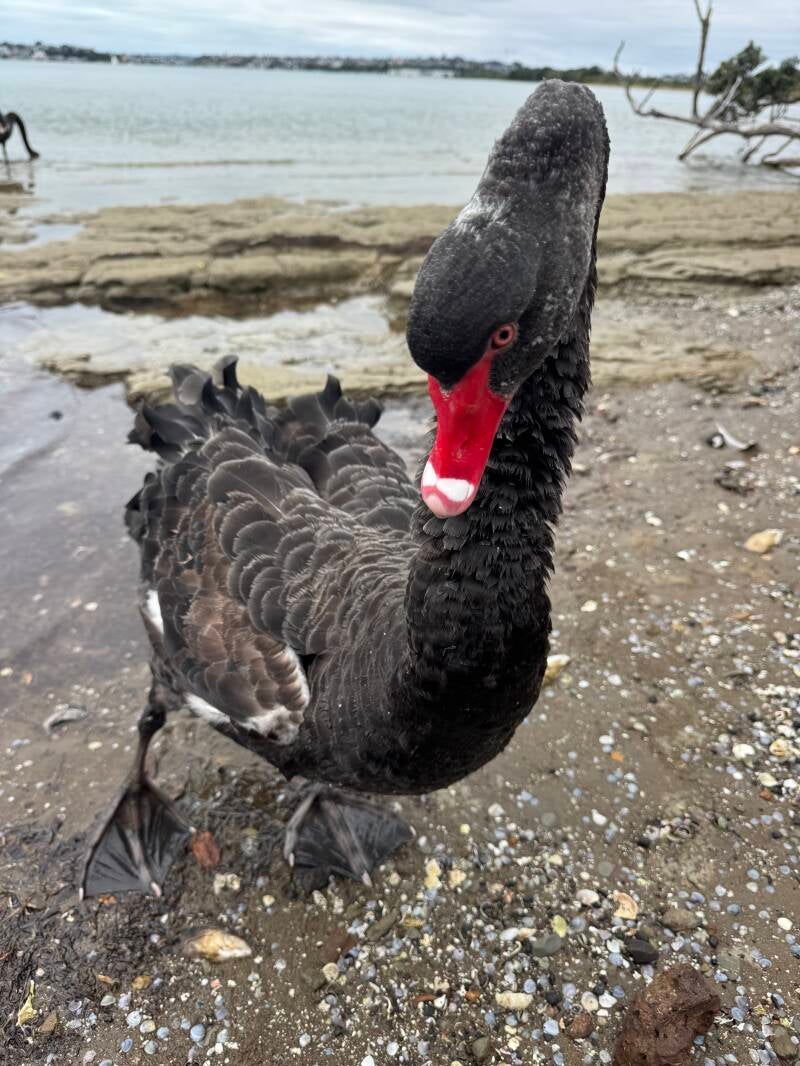
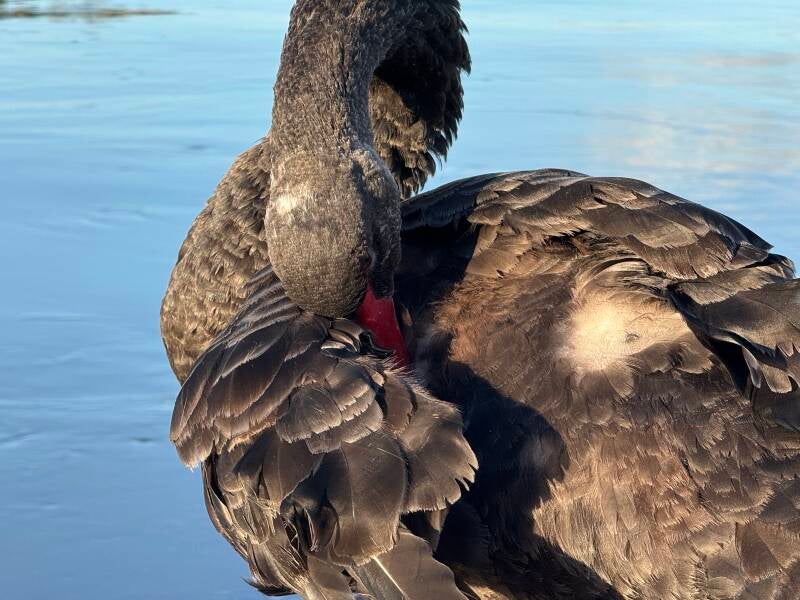
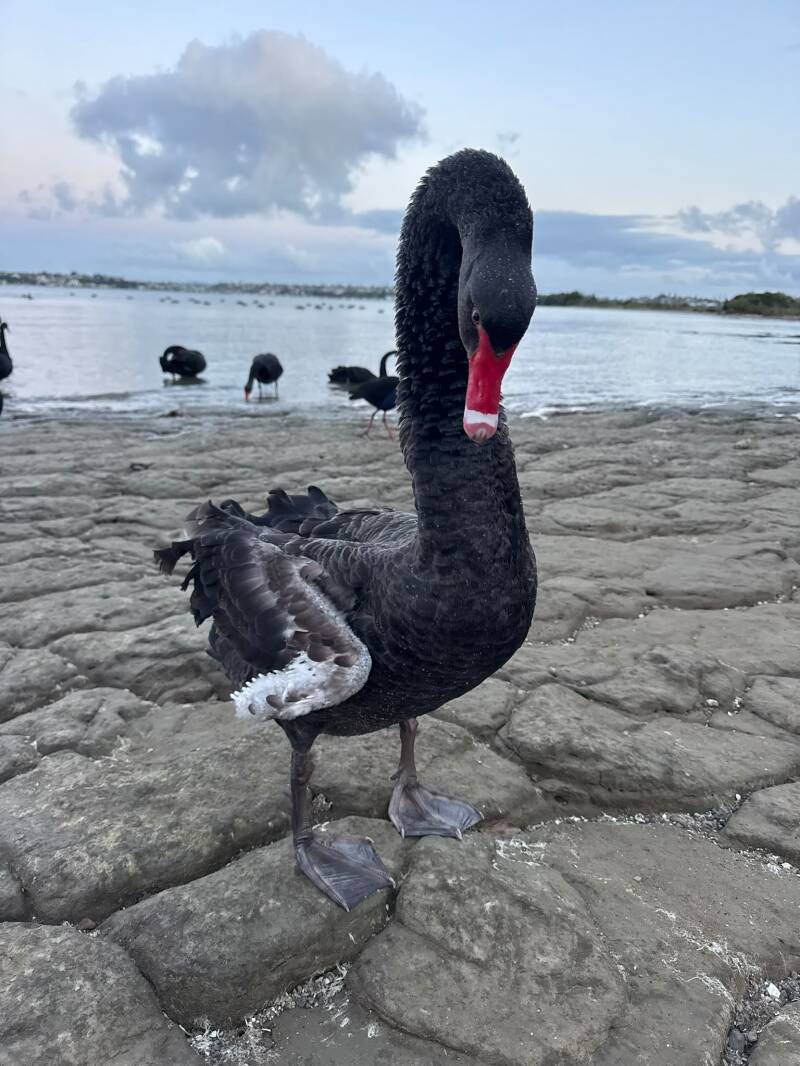
What is known: Images: Swans in moult; photos taken August - October 2026. Hard to fly when you have no flight feathers.
false claim 4: half a kilogram of faeces per day...
false claim 5: ..."an environmental problem"
I can give you a list of St Heliers (environmental) problems... and swans aren't one of them.
What is known: From Hauraki Gulf Forum's Weaving the Strands, 2012:
"Swans signal health -
Black swans in the Waitemata are a sign of improvement in the harbour according [to] Auckland Council biologist Dr Tim Lovegrove. He links their increasing numbers to recovery of Zostera (seagrass) beds on which they feed, particularly around Meola Reef near Westmere.
Recent paleontological studies show that the black swan, although introduced, is probably a naturally occurring species in New Zealand,
because bones from the extinct New Zealand swan are almost indistinguishable from those of the Australian black swan.
“What we are seeing now with the expansion of swans and the recovery of Zostera is a more natural state, probably typical in many sheltered coastal ecosystems in pre-human New Zealand,” says Dr Lovegrove."
Fun Fact: *Meola Reef and the surrounding waterways, where swans have been for decades, is one of the few "green dot" (excellent water quality) areas on SafeSwim across all of Auckland.
a primer on swan poo
Margaret Voyce claims that each swan at St Heliers was producing half a kilogram per day onto St Heliers beach.
What is known: In a study released by Envirolink.govt.nz in 2007, the researchers first cited a former study, saying:
"The only New Zealand study [on swan faecal output] was by a group at Otago University. They calculated the mean daily faecal output of an individual Cygnus atratus to be 418 grams fresh weight or 52 g dry weight of faeces (Mitchell and Wass, 1995). "
The results from the Envirolink study (2007) showed the following:
"Table 3. Data collected on faecal scats of Black Swans during this study
Wet weight of faeces
Mean 44.9 g
95% CI* 37.1 – 53.5 g
Range 14-141 g"
For the purpose of this section, I will use the figure of 418 gram fresh/wet weight/per day as a starting point.
To produce a mean daily faecal output of 418 grams (wet weight), an adult black swan would need to ingest between 500 and 1,250 grams of fresh food per day, depending on the water content of the vegetation and the bird's size. The dry matter ratio would be 50-100gm intake, resulting in approximately 52g dry weight output.
The aquatic plants and algae they consume are roughly 85% to 90% water. When swans feed, they take in large amounts of water alongside the plants. While they absorb nutrients from the plant matter, the excreted scat retains an extremely high moisture content, which is why the total wet weight of the faeces (418g) remains very close to the total wet weight of food digested in some diets.
What this means...
The vast majority of black swan faecal output is water, making up approximately 87.5% of its total wet weight.
If a black swan excreted 418 grams of wet faeces, an average of only 52 grams is actual solid dry matter (organic plant waste, undigested fiber. The remaining 366 grams is entirely water.
So - when Margaret Voyce says that black swans are fouling up the beaches with half a kilo of swan poo each, she is actually overrepresenting the numbers by at least ten times.
But that's not all...
Where and when the swan poo is located.
What is known: Because the swans spend the vast majority of their 24-hour cycle at sea or on the intertidal flats, roughly 75% to 85% of their total daily faecal output is released directly into the open marine water column rather than onto the high-tide shoreline.
If swans output 9 scats per day (as in the literature) and if you were to grossly overestimate the time they spent on the sand to three uninterrupted* hours per day, the scat released onto the high-tide shoreline would be 1.1 per day, with 7.9 per day released at sea.
1.1 scats equates to a wet weight of 51.1 grams (Envirolink puts the mean at 44.9g). When you apply the scientific ratio established in the literature: 87.5% water and 12.5% solid dry matter, this would result in total faecal output per day of 6.39 grams.
Margaret Voyce: half a kilo per day onto St Heliers beach
Science: 6.39 grams per day onto St Heliers beach.
* During the times I have visited, it is rare to see anti-swan locals "allowing" the swans to rest on-shore at all. Usually they are directly, or via their dogs-as-weapons, forcing them back into the ocean. In the context of the on the ground reality, three hours uninterrupted??? Never happens.
false claim: "beach health risk"
St Heliers Residents Association Chairman Bob Smith has been pushing the rhetoric that swans are, or will, infect the locals with e coli. It's worth addressing this point here too as this keeps getting circulated, and has likely been a loud contributor to the decisions being made by the Orakei Local Board.
What is known: E. coli itself is mostly a harmless baseline tracking indicator. The actual danger to humans depends entirely on whether a strain possesses specific human-virulence genes.
Comparatively:
Human Wastewater
- Contains highly pathogenic Diarrheagenic E. coli (DEC), including Enterotoxigenic (ETEC) and Enteropathogenic (EPEC) types. These strains are specialized to bind directly to human intestinal walls.
- Human sewage carries human-specific viruses (like Norovirus or Hepatitis A) and protozoa that require only a tiny dose to make another human severely ill.
- Swans do not carry human enteric viruses
Domestic Dog Waste
- can carry zoonotic strains that cause urinary tract infections (UTIs) or abdominal infections in humans. Can act as reservoirs for multidrug-resistant "superbug" strains due to human antibiotic exposure. Can transmit mammal to mammal (dog to human).
- Dog faeces can harbour tough, soil-persistent parasites like Giardia and Toxocara (roundworm)
- Swans do not carry these domestic dog parasites, nor do they possess mammal to mammal transmission.
Marine Black Swan Scat
- composed almost entirely of commensal (benign) avian E. coli. They lack the specialized plasmid genes needed to survive or cause infection inside a warm-blooded mammalian gut.
- According to the New Zealand waterfowl survey by Moriarty et al. (2011), marine black swans pose a 0% risk for Salmonella and an exceptionally low baseline for Campylobacter.
- being 87.5% water, swan scat dissolves and disperses almost instantly into the ocean. The individual E. coli cells are stripped of their protective matrix and exposed directly to saltwater salinity and solar UV radiation. In an open marine environment, this combination kills off the vast majority of avian enteric bacteria within hours.
For a full overview of all different types of zoonotic bacteria, please see the report referenced below - "INFECTION ECOLOGY & EPIDEMIOLOGY, 2017"
Comparative e. coli Load:
What is known:
Using the formula Daily Load = Daily Dry Matter (g) x Bacterial Count per Dry Gram:
- A single dog = 58g of dry matter x 172,000,000 CFU/g = 10 billion to 17 billion E. coli cells daily.
- A single human (via Wastewater) = 30g of dry faecal matter x 400,000,000 CFU/g = 12 billion E. coli cells daily.
- A single swan = 52g of dry matter x 240,000 CFU/g = 12.5 million E. coli cells per day.
To put this into perspective using dry weight mathematics: It would take the daily faecal output of roughly 800 to 1,360 marine black swans to equal the daily E. coli contribution of a single dog, and even more to equal that of a single human wastewater contributor.
potential disease transmission
What is known: The following information is from INFECTION ECOLOGY & EPIDEMIOLOGY, 2017 - https://doi.org/10.1080/20008686.2017.1300450
"Potential disease transmission from wild geese and swans to livestock, poultry and humans: a review of the scientific literature from a One Health perspective"
Contributors include:
Division of Natural Sciences, Kristianstad University, Kristianstad, Sweden;
Department of Animal Environment and Health, SLU Swedish University of Agricultural Sciences, Skara, Sweden;
Department of Health Care Sciences, Ersta Sköndal Bräcke University College, Stockholm, Sweden;
Centre for Ecology and Evolution in Microbial Model Systems, Linneaus University, Kalmar, Sweden
"Escherichia coli (E. coli) is a bacterium that can normally be found in the intestinal tract of humans and animals, including birds. Most strains are harmless and often considered part of the normal gut flora in vertebrates. For example, mute swans can carry E.coli bacteria (60%; n= 15) without showing any symptoms of disease. However, some E. coli strains have pathogenic properties, often plasmid mediated, and can cause diarrhoea and systemic illness in humans and/or animals, i.e. they are zoonotic. E. coli can be spread by
food and water contamination. From a human health perspective, only strains carrying human virulence factors are of importance."
"In summary, it is difficult to draw any firm conclusions about the risk of transmission of E. coli from geese and swans to livestock or humans, other than that in most cases the E. coli found show low prevalence of human virulence factors and is hence not an important source of zoonotic infection."
"In an extensive general review, Tsiodras et al. concluded that many wild bird species can serve as reservoirs or vectors for a number of different pathogens, but they found only one case of direct transmission from wild geese and swans to humans (a cluster of HPAI H5N1 infections in people plucking feathers from dead mute swans), and also relatively little evidence for indirect transmission.
Overall, they argued that direct transmission from wild birds in general play a limited role in human infectious diseases. They also emphasized the importance of effective public information campaigns to put perceived risk into perspective, stressing that public activities in areas with abundant wild birds carry minimal risk, in particular if people refrain from possible risk activities such as unprotected handling of dead, wild waterfowl.
In this context it is worth noting that several European countries now allow or even promote intensified goose culling (e.g.), which would increase direct contact between geese and humans. Although wild geese and swans, based on present knowledge, have a very limited role in zoonotic disease transmission, we have noticed that publications directed towards the public or staff involved in managing geese tend to emphasize rather than downplay disease transmission risks. Although sometimes stated that such transmission is not well understood or documented, a general advice is nevertheless to minimize direct contact between humans and goose faeces."
"The potential for zoonotic disease outbreaks linked to migratory birds, including geese, is often much exaggerated in media, which may influence public perception of these birds.
"Our present synthesis demonstrates that swans and geese can be colonized/infected by a number of microorganisms that can cause disease . ELMBERG ET AL. in humans and/or domestic animals, although for some of these microbes there are uncertainties about their host-specificity. However, there is very little evidence of such transmission actually taking place, and we therefore argue that although there are potential risks, these are often exaggerated in line with the precautionary principle. This may divert attention from more relevant risk factors."
"It is worth underlining that our analysis does not point out any pathogen at all in which geese and swans play a truly significant role for zoonotic spread compared to other wildlife, at least not from a European perspective... From a One Health perspective, this risk of disease spread must be weighed against positive contributions by swans and geese, for example as ecosystem engineers, biodiversity, and other ecosystem services.
We would like to point out that this review focuses on specific disease transmission only. "
Swim Guide - water quality results for st heliers bay 2013 - 2026
The data below shows the quarterly historic water quality results from St Heliers Beach. Measurements are taken daily.
As can be seen, water quality has fluctuated since 2018, in line with the publicly available reports regarding St Heliers Beach ongoing (human created) wastewater contaminants entering the Bay.
What is also clear from the data below is that during the period where the swans are alleged to have been significant contributors to "problems" - "the last few years" - the water quality measures have actually shown improvement.
What is known: The primary driver for poor water quality at St Heliers is stormwater overwhelming the wastewater network during heavy rain. Severe weather events in January 2021, December 2023, and January 2026 repeatedly triggered "red" (high risk) or "black" (do not swim) flags due to untreated sewage entering the bay.
What is known: In February 2023, a localized infrastructure failure caused by a landslide forced a temporary "black flag" warning at St Heliers and neighboring Kohimarama, when broken lines directly leaked wastewater into the coastal margins.
What is known: In December 2025, St Heliers faced prolonged closures when it was black-flagged. Council investigations tracked distinct faecal contamination to wastewater leaking into a localized freshwater stream around Dingle Road.
Here are some further articles on the continuous closures that long pre-date the swans, and the continued closures due to human wastewater issues:
Dirty water raises health risks at Auckland beaches
Private pipes blamed for leaking human waste onto Auckland beaches
'Poo tracker' shows extent of sewage in Auckland's beaches
St Heliers beach off limits after wastewater floods bay
At least 25 Auckland beaches deemed high risk, four closed over high levels of faecal bacteria
Most Auckland beaches unsafe for swimming after wastewater overflows
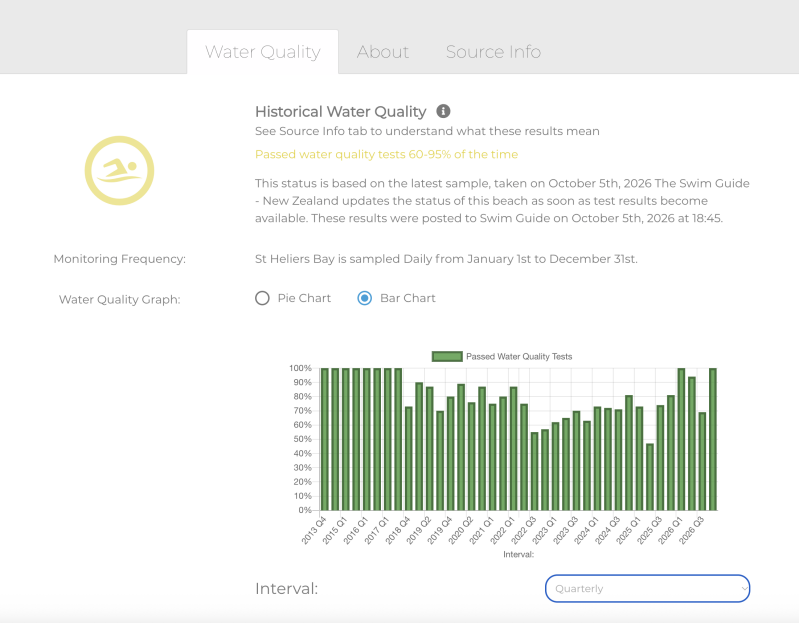
https://www.theswimguide.org/beach/5906/
Source Information
Beaches in Auckland are monitored by Safeswim, a program which emerged out of a partnership between Auckland Council, Surf Life Saving Northern Region, and Auckland Regional Public Health Service. Safeswim forecasts water quality and real-time public health alerts and safety risks at 84 beaches and 8 freshwater locations around Auckland.
Safeswim uses predictive modelling to provide the public with real-time water quality and safety information. Predictive modelling allows Safeswim to forecast recreational water quality so that bathers and other recreational water users have better access to the current and future status of their beaches. This allows recreational water users to make better, more informed decisions about when and where to get in the water.
Water quality predictions are made using statistical modelling. Models include historical and current water quality test results, as well as other environmental factors such as wind, rain, tides, and sewage events like CSOs. Safeswim’s models are updated every 10 minutes, and display results using 3 risk categories: People are exposed to very low risk of infection from contact with the water. The beach’s water quality doesn’t present an immediate health risk to those in direct contact with it. People are exposed to a low to moderate risk of infection from contact with the water. This is the minimum acceptable state. The beach’s water quality still meets an acceptable standard for swimming. People are exposed to a moderate to high risk of infection from contact with the water. The beach’s water quality is considered unsuitable for swimming.
Swim Guide interprets these categories in our pass/fail system as: Very low risk and low to moderate risk categories receive a GREEN/PASS in Swim Guide. Moderate to high risk categories receive a RED/FAIL in Swim Guide. The predictive models use New Zealand’s Ministry of Health and Ministry of the Environment’s Microbiological Water Quality Guidelines for Recreational Water.
The Guidelines are: Marine water : Single sample value > 140 Enterococcus / 100 ml Freshwater : Single sample value > 260 E.coli / 100 ml
State of the Gulf Official reports
The 2026 State of our Gulf report has now been released. I would encourage everyone with genuine concerns about environmental issues to read it.
* spoiler: there is a very long list of contributors, and swans aren't in it
* spoiler: humans are the primary and dominant cause
Here's a summary from State of our Gulf 2026, where St Heliers lies.
"What remains under pressure
Despite [this] progress, the Gulf remains under significant, and in some cases increasing, pressure.
Sediment and contaminants from land-based activities continue to affect water quality and seafloor habitats. Auckland Council assessments found only 2% of monitored estuary sites in excellent condition. Every monitored estuary showed at least moderate impacts from excess land-derived sediment. The Firth of Thames was declared a degraded water body in 2025, with the Waihou and Piako among New Zealand’s most nitrogen-loaded rivers.
Marine biodiversity remains under stress, with ongoing loss or degradation of habitats that support the wider food web. Some fish stocks and shellfish populations continue to show decline or slow recovery. This is evident in the request from three iwi within Pou Rāhui, Ngāi Tai Ki Tāmaki, Ngāti Tamaterā and Ngāti Paoa, for two-year extensions to their existing Section 186A Applications with Fisheries New Zealand supporting rāhui over shellfish species within their rohe.
New pressures are also emerging. The spread of exotic Caulerpa and the increasing frequency of marine heatwaves are affecting ecosystems in ways that are not yet fully understood, but already frightening.
For many people, these changes are experienced over time in what is caught, what is seen, and what is no longer there.
Climate change is intensifying the system
Climate change is no longer a future pressure. It is already influencing the Gulf.
Warmer waters, more frequent extreme weather events, and changing ocean conditions are increasing stress on ecosystems and compounding existing pressures. In some areas, change is occurring faster than recovery.
Marine heatwaves offer a clear illustration. During heatwave conditions pakahā / fluttering shearwater are forced to travel further to find food, with foraging trips doubling in length, reducing breeding success and leaving adults and chicks in poorer condition.
Response is increasing, but not yet at scale
Action across the Gulf is more visible, coordinated, and collaborative than in the past. Mana whenua continue to uphold their responsibilities as those with whakapapa to the rohe, exercising mana and rangatiratanga through efforts to restore and revitalise Te Tīkapa Moana / Te Moananui-ā-Toi. Community involvement is growing. Investment from philanthropy, policy change, and collaboration are enabling a broader range of responses.
While actions are increasing, the overall picture remains uneven.
With much of the directorial effort landing relatively recently, it is too soon to see measurable outcomes from this investment and decision-making. It will need to translate into consistent, system-wide improvement at the scale required for positive impacts to be explicitly seen.
The key issue is not whether effort is underway, but whether it is occurring at the pace and magnitude needed for lasting regeneration. For example, the designation of High Protection Areas in 2025 and manual removal of kina can kickstart recovery, but this requires reduced fishing pressure across the wider environment, so that natural predators like tāmure and kōura can keep kina in check, and healthy, productive ecosystems can be sustained long term.
Overall state of the Gulf: Mauri heke / Under pressure
Te hurihanga tai – a turning tide.
Three years ago, the last report found a system under pressure, with water quality, habitat condition, and key species already degraded or variable. This report finds the same indicators, but the pressure has not eased. It has compounded.
At the same time, there are visible signs of response, including restoration activity, closures in line with the Hauraki Gulf Fisheries Plan, and localised recovery in some areas, such as the return of kiwi to Waiheke, and the reestablishment of tīeke / saddleback on Rakitū Island after more than 50 years.
The direction of change is not yet fixed. There is still time to restore mauri, but the window is narrowing. With a warming climate and unpredictable weather systems setting in, every lever within our control must be pulled to regenerate and maintain a resilient system, or the next report will be painting a much starker picture.
- Hauraki Gulf Forum, July 2026
Official Stance on Water Quality:
What is known: Dr Imogen Bassett, head of Auckland Council’s Natural Environment Specialist Services, has clarified that the swans do not pose an ecological threat. Even from a water safety perspective, tidal movements wash away any droppings, meaning water quality is unaffected by the swans.
True Source of Issues: Watercare, Safeswim, and environmental scientists confirm that the primary drivers of "red" or "black" flags at St Heliers remain sewage, wastewater pipe failures, and stormwater overflows following heavy rain.
Further Water quality reports and science can be found here -
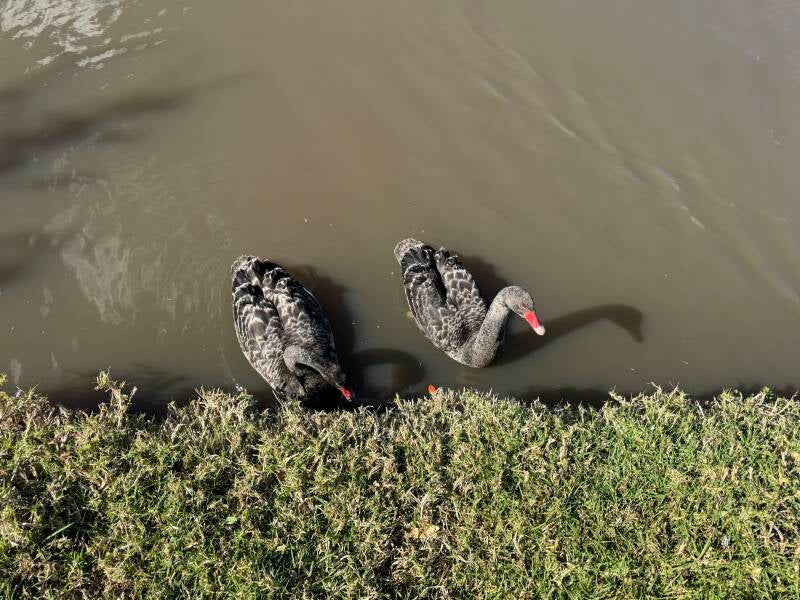
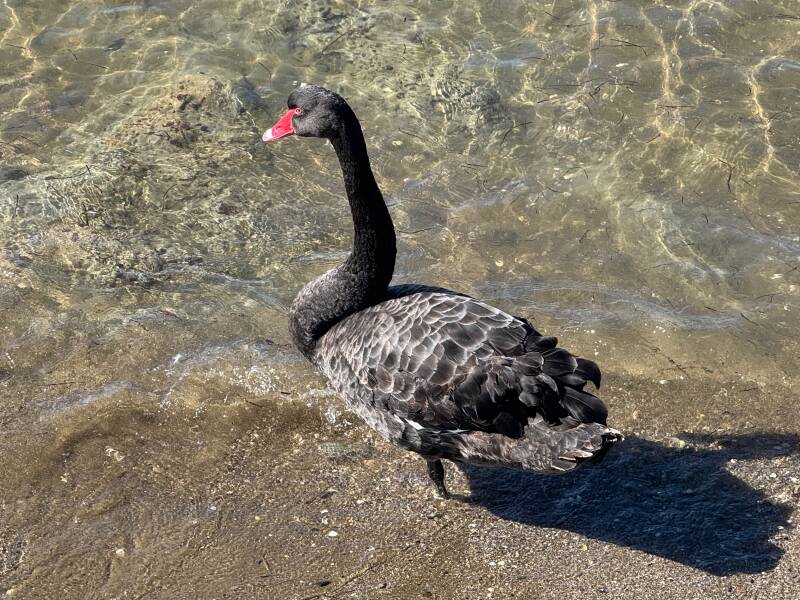
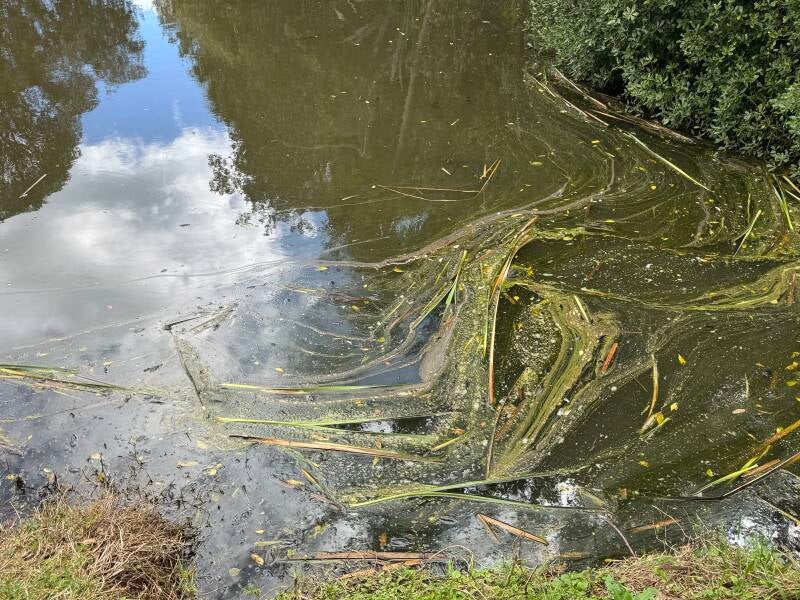
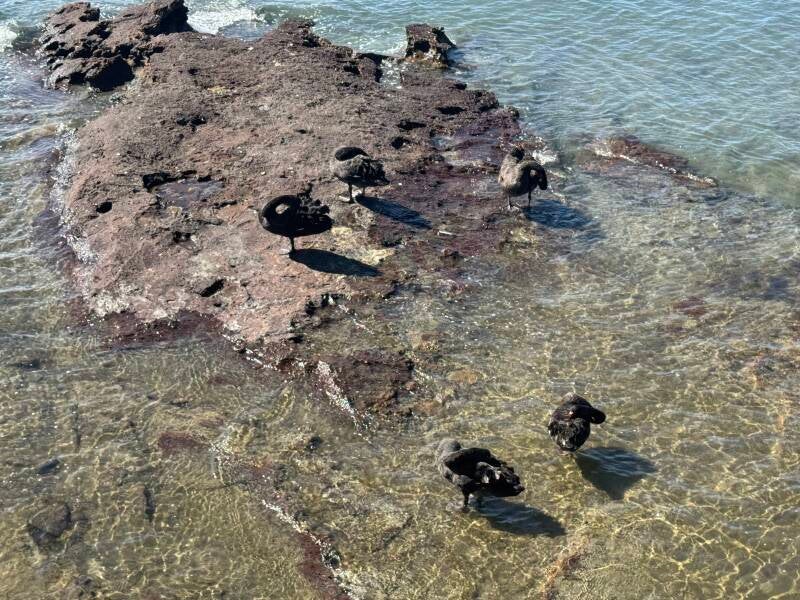
Images: Current unaddressed pollutants and siltation at Tahuna Torea Nature Reserve Freshwater Pond 2026 (left column) versus current water quality at St Heliers Beach 2026 (right column). Both fall under Orakei Local Board's Environmental Portfolio. Yet only the clear water of St Heliers is getting the alarmist treatment.
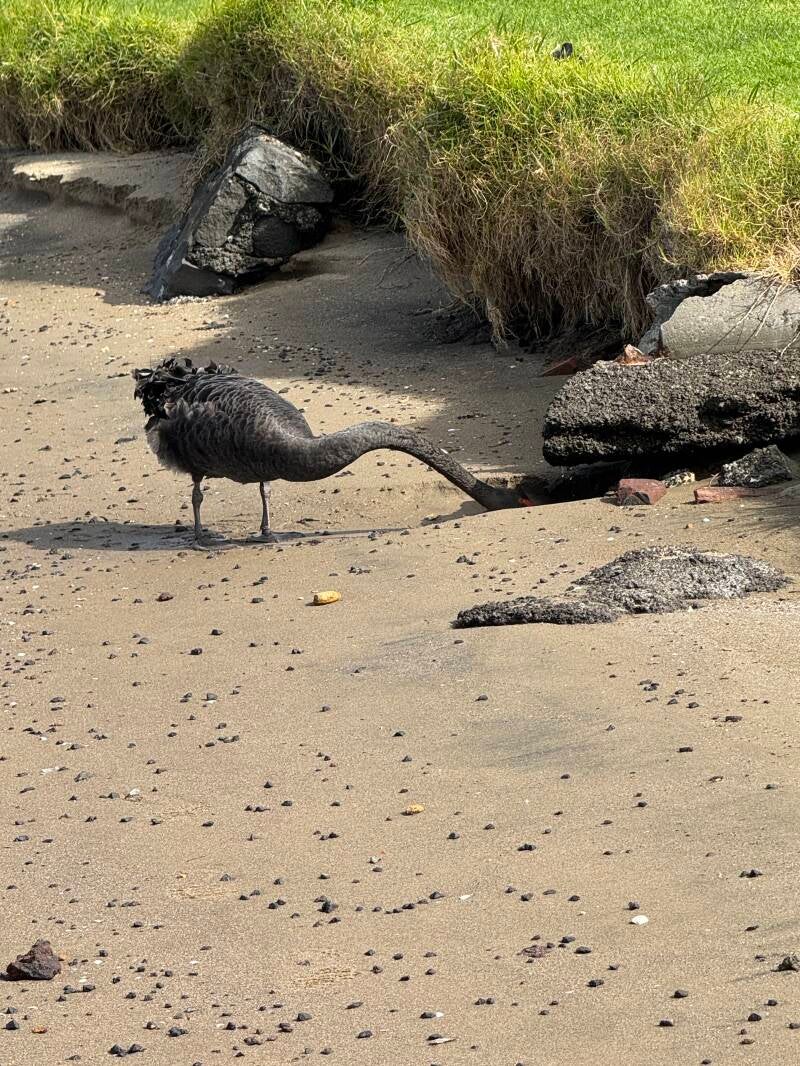
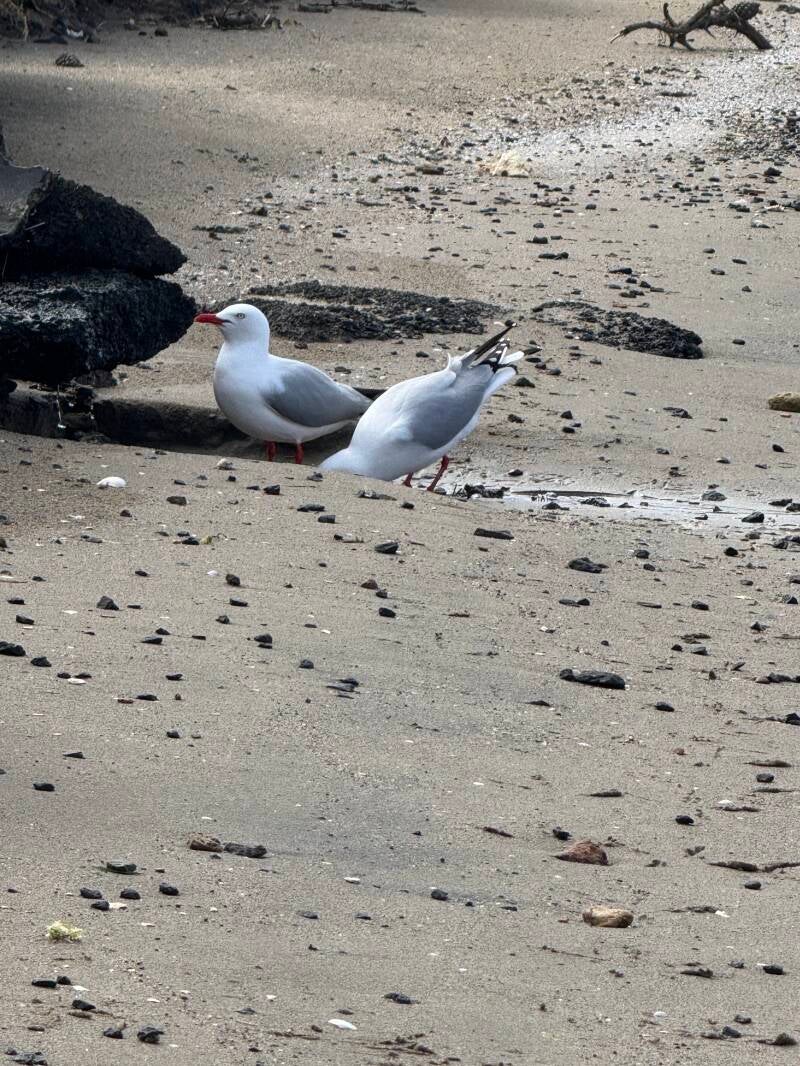
Images: Birds at Tahuna Torea Bird Sanctuary seeking water from waste pipes over pond water 2026
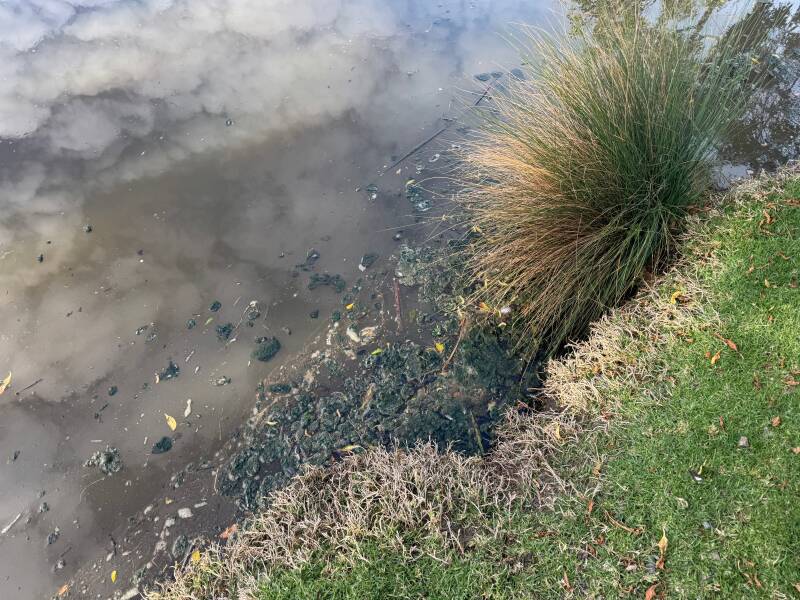
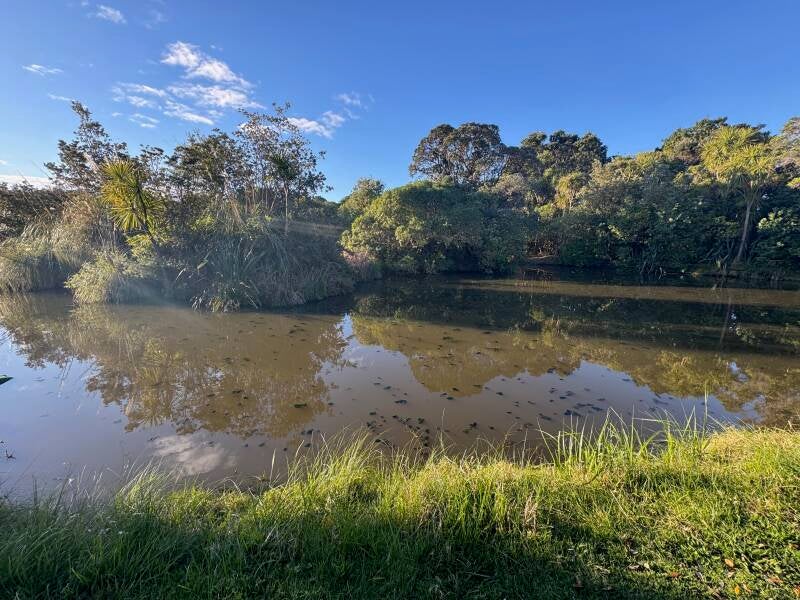
Above images: Unaddressed water quality (run off, environmental pollutants and siltation) at Tahuna Torea Bird Sanctuary's freshwater pond - as at 9 October 2026. The ONLY fresh water pond source near St Heliers.
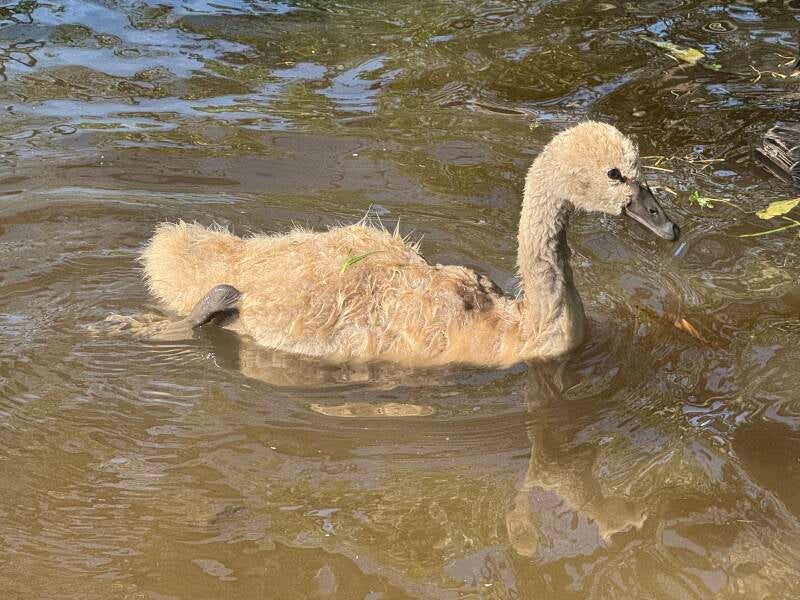
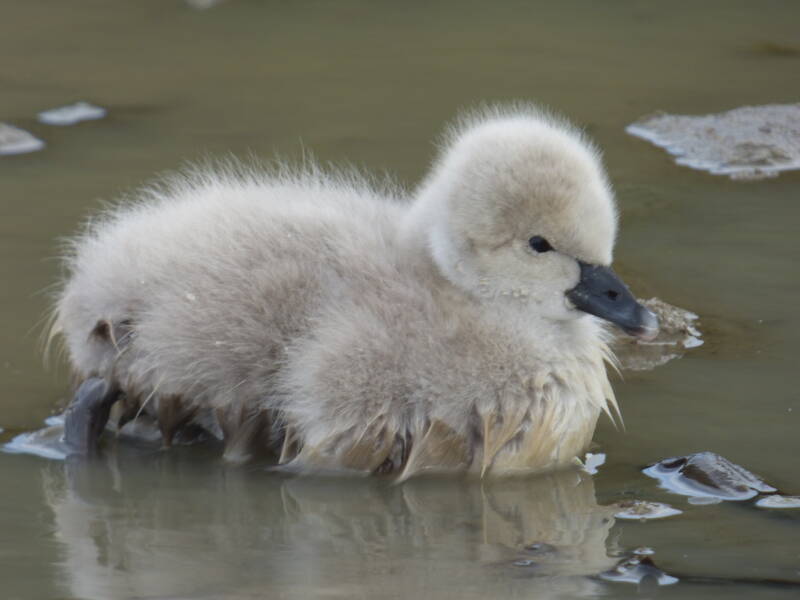
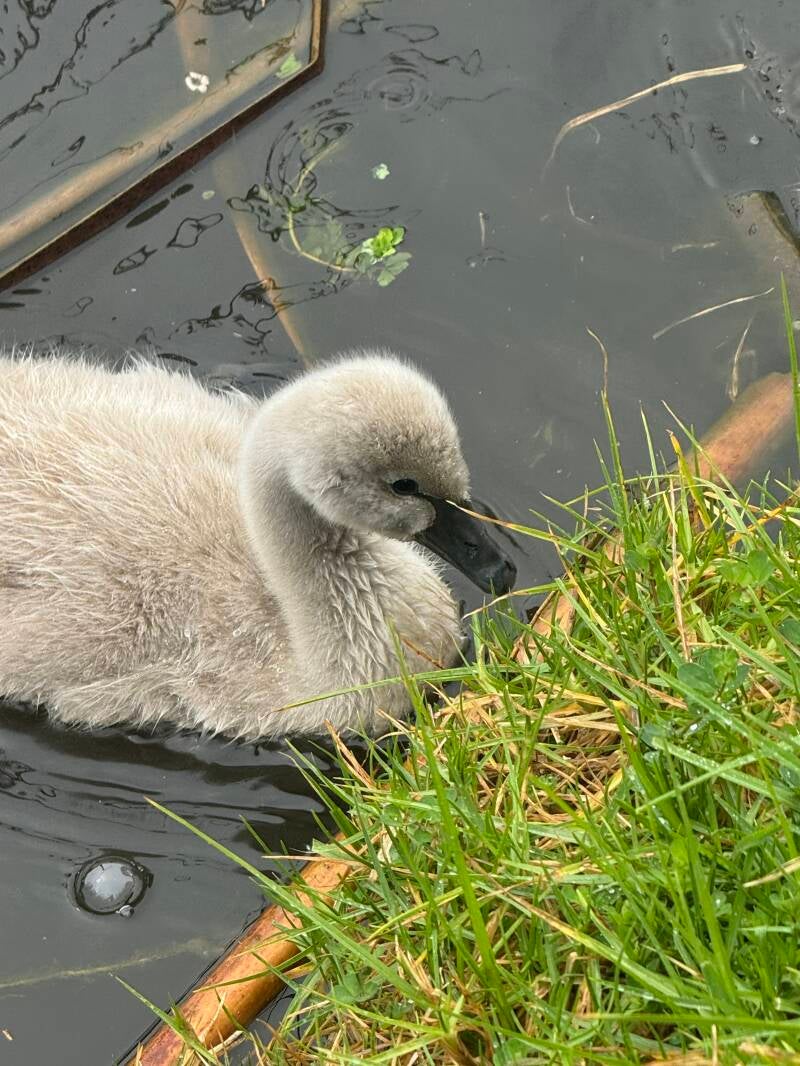
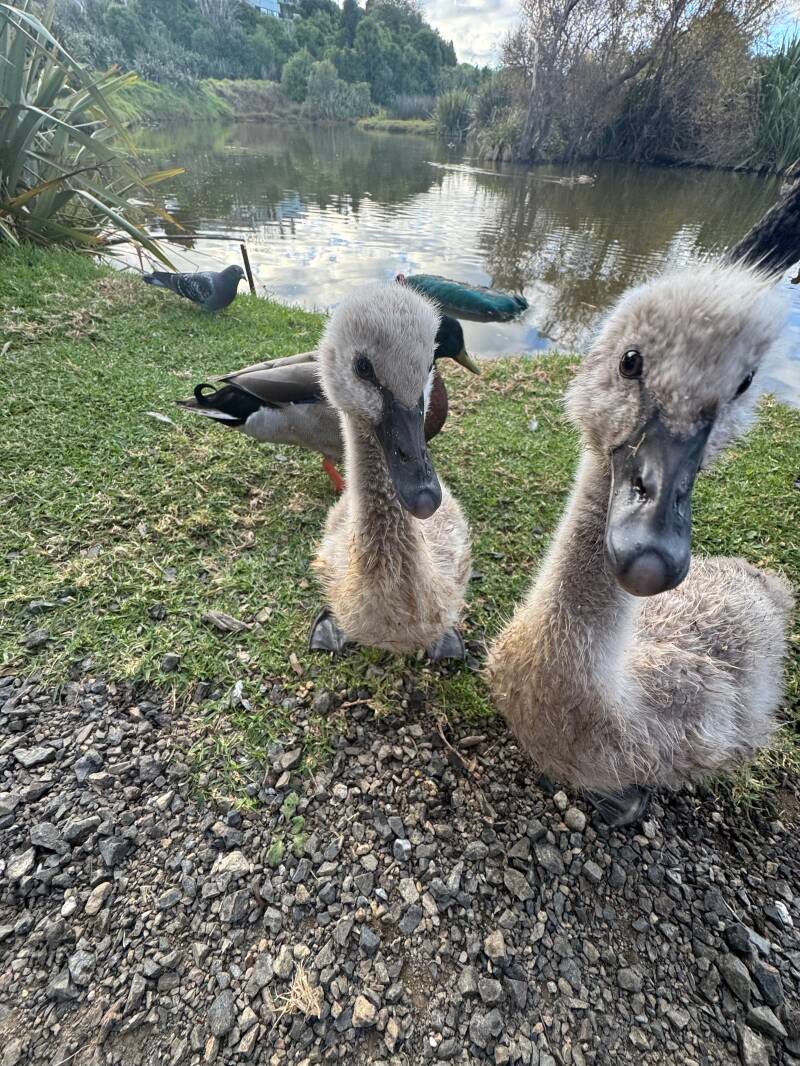
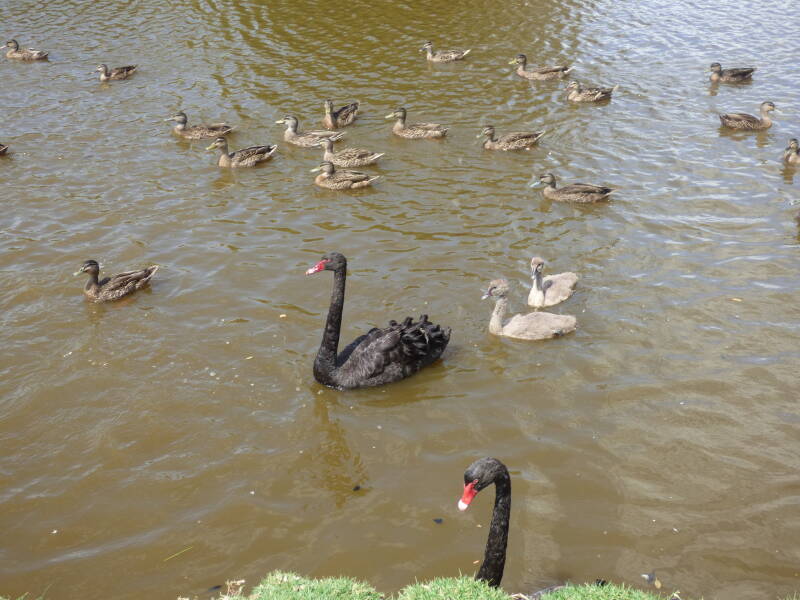
Images: The true victims. The comparative legacy year-on-year that cygnets get left by human waste. Photos from 2024 - 2026
false claim 6: the clean up effort
What Margaret Voyce and resident Association Chair Bob Smith fail to mention in their many public social media and press media reports about this "effort" are the following, quite crucial facts:
What is known: The "clean-up effort" was the first and only time that a clean up has been done in the 5 years that the swans have been in St Heliers. So what they found was the sum total of what wasn't flushed out across that entire time period.
What is known: The "clean-up effort" was organised on an incoming tide. In effect, and possibly to garner as much shock value as possible (?), 'evidence' was gathered BEFORE the tide would have naturally taken most, if not all, of it away.
What is known: Margaret Voyce made a further claim on social media that just 'hours later' she returned to the beach and it was 'the same' as it had been before the clean up. If you look at NIWA tide times, this would have aligned with high tide - when there is almost no exposed beach on which to find swan poo, let alone exposed beach where the swans could have come ashore in that "few hours" window. The idea that Margaret Voyce returned at high tide and discovered what she implies is a fresh '21 kilos worth' is complete fiction.
What is known: The tidal shelf: Tide heights vary and especially after storms, you will find that the sand forms shelves from the force of the water. When this happens, it takes some time for the sand to return to a sloping surface. In some instances, this results in debris sitting on or above the shelf until the sand resettles, and the tide can resume sweeping away whatever is on or above the shelf.
What is known: If you look at where the swans are, it is a small section of beach, at primarily the Long Drive end (less than 10-15m). Therefore, any swan poo that would be on the beach is also in this small area. It is not widespread throughout the beach, and is easily avoided by using THE OTHER SIX HUNDRED PLUS METRES available.
What is known: Dogs, and other wildlife, regularly poop on the beach. Many bird species poop from the sky or on the ground. Many more ocean critters poop in the sea. Margaret Voyce makes no mention of this, nor that St Heliers employs a regular beach tractor/grader service through the central portion of the beach to regularly turn the sand and make it look nice. Within this lovely sand is still all the other poo combined. Why doesn't this combined animal faecal content seem to be an issue? If kids can't play in the sand because of swan poo, then why can they play in the poop-sand of all other creatures? Given the visibility of swan poo - at least you know where it is, unlike the rest of it, no?
What is known: The quoted figure of 'half a kilo per day': a swan, like all other animals including humans, can only poop in proportion to what they eat. Without knowing how much food they are eating, how can one state what their output is? The study from which Margaret Voyce is (mis)quoting is regarding swans in an enclosed non-tidal, non-flushing freshwater lake; the output was actually 418gm wet weight; and the study conditions were where the food sources were abundant and easily accessible. As already covered in previous sections, based on time and location, the total dry weight 'output' is actually around 6.39 grams per day.
What is known: Swans in open marine environments are limited by many factors, such as tide times, food availability, depth and accessibility of food sources, weather conditions, health, age and size, and the list goes on. On storm days, swans may have no access to food at all in which case their output will be zero. Given that many St Heliers swans were observed with low body condition scores, that correlates to insufficient nutrition, not maximum nutrition. What they are eating also impacts what they are outputting, based on the different densities in different food sources.
What is known: Without any data whatsoever to support her claim, it is - at best - speculation based solely on a report of different swans living in a freshwater lake, not in Auckland, under completely different conditions. At worst, it is deliberate misrepresentation from a member of local government.
false claim 7: "the public is concerned about the sharp increase in numbers"
1. "The public" is not concerned about this. A small organised group of locals, primarily led by the St Heliers Residents Association, in tandem with Orakei Local Board, don't want them there and the reasons given have been addressed and debunked by all the agency experts and all available scientific research.
2. What sharp increase in numbers? The most recent eBird count showed just 1 swan. The most recent public sighting (22 Oct) counted 12. Even at Tahuna Torea bird sanctuary, there has been a 70% drop over the last 22 months.
The reality from the frontlines (not found in a boardroom)
The underlying narrative from Margaret Voyce, the Orakei Local Board and the St Heliers residents Association has been to propogate the idea that local swans are breeding uncontrollably, overwhelming the regional ecosystem with new offspring. Empirical local tracking data completely refutes any claims of runaway breeding or high juvenile survival within the local board area.
What is known: Across the entire Ōrākei Local Board footprint, there is only one single viable nesting site, which houses just ONE nesting pair. It is located within the sheltered wetlands of Tahuna Torea. The nearby Stonefields is down to only one swan, so no breeding pairs there.
A standard, healthy Black Swan nest averages a clutch size of 6 to 8 eggs (a biological mean of 7 eggs per nest). Over the last 21 months, only two resident pairs have attempted to breed, resulting in a total of just 5 nesting attempts. This represents a baseline biological potential of roughly 35 total eggs laid. Out of those 35 potential eggs, only 7 eggs successfully hatched. Of those 7 hatched cygnets, only 6 survived past the critical two-week mark.
Today, out of those historical attempts, only 3 individual juveniles are known to have survived in the area (one yearling approximately 12 months old, and two cygnets approximately 6 months old). From the moment of hatching, the local juvenile survival rate stands at 42.86% (3 survivors from 7 hatched). When calculated against the total biological potential of the clutches laid, the total survival rate drops to a staggering 8.57% (3 survivors from ~35 eggs).
Spread across the local regional flock of approximately 300 swans, primarily based at Tahuna Torea Bird Sanctuary, the addition of 3 surviving juveniles represents an annual population recruitment rate of just 1.00%. Far from an uncontrollable breeding boom, the local population faces an extraordinarily high rate of reproductive attrition. A recruitment rate of 1% over nearly two years demonstrates a population that is heavily failing to replace its natural mortality rates locally.
What is known: The death toll, and number of injured or sick black swans in the Orakei Local Board area over the past two years has been consistent, and extremely worrying.
Below is a slideshow of just the ones that I have found. In open marine environments, most would be swept out to sea, so the death toll is far higher than these photos show.


Rather than experiencing an unchecked population boom, field observations from the Ōrākei Local Board area document a severe, high-attrition mortality rate directly caused by urban hazards, lack of domestic animal control, and severe environmental stress.
What is known: Within the identical 21-month period of January 2025 - September 2026, localized rescue and monitoring efforts have documented 23 dead swans (not including all cygnets) that either succumbed directly to local trauma, starvation or dehydration or required immediate humane euthanasia due to human-induced injuries or organ failure.
What is known: In direct opposition to claims that the birds are over-resourced and thriving, multiple local mortalities have been scientifically linked to starvation and dehydration. Because marine intertidal zones do not provide freshwater access, displaced swans require periodic access to terrestrial fresh or brackish water sources and shoreline foraging buffers. Field monitoring and veterinary reports have confirmed the deaths directly caused by deliberate human interference blocking access to these critical spaces. Hostile human encroachment, unauthorized shoreline barricades, and public harassment have physically cordoned off the birds from localized freshwater sources and stable feeding areas, forcing them to perish from systemic dehydration and malnutrition.
What is known: Urban shoreline vulnerabilities have resulted in at least 6 known dog maulings (2 at Tahuna Torea, and four at St Heliers Beach), five of which were immediately fatal to the protected swans.
What is known: Because a high percentage of swans that die or are injured within the open intertidal zones are silently washed out to sea by strong currents without being accounted for, the actual mortality rate is significantly higher than public tallies show.
The local swan flock is not an "unchecked pest" needing human population management. It is a highly vulnerable, displaced native flock experiencing an unsustainable combination of low birth rates (1% regional recruitment) and severe, multi-faceted mortality directly exacerbated by human exclusion tactics and illegal domestic animal attacks.
* 2025:
- 12 definitive deaths across March (3), April (2), May (1), July (2), August (3), September (2) and October (1). Total does not include cygnet deaths.
- Other members of the public reported a dog mauling and dead swan at Roberta Reserve on 19 March 2025. On 11 October 2024, we had seen another mauling of a swan involving two dogs at Roberta Reserve. Evidence of which was given to Auckland Council.
- 3 near-fatal poisonings in June (3), one fatal poisoning in April.
- Multiple dog maulings in Glendowie and St Heliers Beach. Multiple injuries.
* 2026:
- 11 definitive deaths across March (2), April (2), May (3), July (1), August (1), October (2). Total does not include all cygnet deaths.
- 1 fatal poisoning of a two week old cygnet in May
- Multiple fishing injuries, multiple dog maulings in Glendowie and St Heliers beach.
Again, these are just the ones I have found.
The Math: January 2025 - September 2026
Births with survival to 9 months old = 3.
Deaths in same period (not including all cygnets or those washed out to sea) = 25
Injuries and dog maulings from same period = ongoing, and numerous
Total Population Increase from within Orakei Local Board area (2025 - 2026) = MINUS 22 (minimum)
FALSE CLAIM 8: artificial propping
Member Margaret Voyce publicly targeted local volunteers, myself included, claiming that feeding routines are "artificially propping up" numbers and altering wild behaviors at St Heliers Beach.
Member Margaret Voyce has completely inverted the nature and volume of local volunteer intervention. Rather than distributing mass handouts to sustain a healthy wild population, local volunteer care consists of highly disciplined, targeted rehabilitative therapy for compromised birds, of which Margaret is aware. And has been aware of for the past few years.
Volunteer support involves providing wildlife-vet-approved specialty grains and greens. This is target-fed to sick, underweight, struggling or recovering swans who require immediate clinical support to survive anthropogenic trauma.
What is known: Avian veterinary science confirms that wild waterfowl suffering from severe illness, injury trauma, or starvation undergo extreme metabolic stress. A recovering swan's metabolic rate accelerates significantly, requiring up to twice the standard daily caloric intake compared to a healthy bird simply to sustain tissue repair, thermoregulation, and physiological stabilization.
What is known: The absolute maximum volume provided through targeted, wildlife vet approved and recommended local care represents a statistically insignificant fraction of a percent of the flock's caloric requirements. The freshwater is often critical.
What is known: The swans have returned to the Eastern Bays due to the natural recovery and expansion of intertidal seagrass beds (Zostera muelleri) across the Waitemata Harbour, the Tamaki Estuary and local mudflats. Black Swans are specialized, obligate herbivores. They are at places such as St Heliers Beach because it has a natural pasture of their primary native food source, and access to life-saving fresh water, not because of local volunteers. If volunteers were causing them to stay, why would they have reduced by 70%??? If they were all being fed, why are so many dying of starvation?
What is known: Targeted volunteer intervention of poisoned, injured, starved and dehydrated swans would not be necessary if Member Voyce and the Ōrākei Local Board were properly executing their environment portfolio mandates.
The community has been forced to step in and absorb the financial and emotional costs of wildlife rescue and recovery because the local board has systematically failed to take basic, actionable measures to prevent wildlife injuries and deaths, mitigate dehydration and starvation, secure freshwater access points, manage irresponsible dog ownership and provide public education and information about the true native protected status and needs of black swans across local shorelines.
What is known: They have ignored two years of official complaints and concerns raised via local advocacy groups, as well as official channels by email, escalated complaint letters and Council reports, and have failed to investigate or enforce the basic responsibilities of the Wildlife and Dog Control Acts.
Local volunteers are undertaking emergency wildlife response to fill the ecological void left by the local board's paralysis.
To scapegoat the public in order to justify a failing narrative is not only unethical, but an egregious breach of local government's code of conduct.
FALSE CLAIM 9: "THEY'RE BREEDING TWICE A YEAR WHICH ISN'T USUAL FOR A BLACK SWAN"
Member Margaret Voyce claims that human feeding is causing them to unnaturally breed twice a year.
What is known: Avian physiological research confirms that multiple nesting attempts within a single extended window are driven by a compounded stress response and high infant fatality, completely independent of low-level human intervention.
What is known: Large waterfowl exhibit a biological phenomenon known as "replacement clutching." When a pair faces a total or near-total clutch loss (high infant fatality), or experience severe physiological stress due to a critical deficit of suitable, safe nesting sites, their endocrine system triggers a rapid re-nesting response to mitigate reproductive failure.
Across the Ōrākei local Board area, the lack of available freshwater nesting habitats has forced pairs to compete over the single viable location at Tahuna Torea. This extreme spatial stress, combined with the documented loss of 80% of their hatched young to urban hazards, is what forces these birds into exhaustive, repetitive nesting loops.
What is known: Peer-reviewed metabolic data shows that intermittent food offerings cannot provide the complex proteins and massive caloric reserves required for a female swan to undergo vitellogenesis (egg production). And certainly can not create a twice-yearly nesting behaviour in an environment that does not support nesting. The birds rely exclusively on the intertidal seagrass beds to fuel their biology.
Misrepresenting a stress-driven survival mechanism as a consequence of human feeding is an egregious distortion of basic avian biology.
It's also worth noting that there are no nests (now or ever) in St Heliers where Margaret claims this is happening.
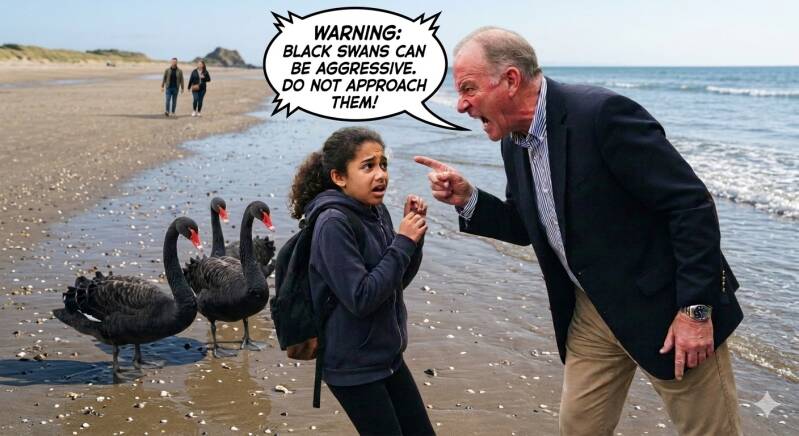
false claim 10: "they can be aggressive, especially if you get between them and their baby, people go to the beach with their children and they're big birds"
Member Margaret Voyce publicly claimed that the swans at St Heliers Beach present an active physical danger to children because "they can be aggressive, especially if you get between them and their baby".
Black Swans do not, and cannot, breed or nest in open marine environments, making the claim of "beach nest defense" behavior biologically impossible.
What is known: Official breeding atlas surveys from BirdLife Australia indicate that black swans will never successfully rear cygnets directly in marine waters. While adults possess supraorbital salt glands to filter and pump excess sodium out of their nostrils, cygnets are hatched without this function fully formed. If a clutch is laid near an ocean inlet lacking a connecting freshwater creek, cygnets suffer 100% mortality from salt toxicosis and dehydration within days.
What is known: Black swans requires stable, non-tidal freshwater or brackish wetlands, inland lakes, or highly sheltered lagoons to breed. They construct massive, heavy nests out of terrestrial and aquatic vegetation that must remain static on or near fresh water.
What is known: St Heliers Beach is an open, high-energy marine environment subject to constant tidal changes, wave action, and high salinity. Swans are anatomically and behaviorally incapable of constructing or maintaining a nest in such a habitat. Because there are no nests or cygnets reared at St Heliers Beach, no nest-defense behavior can occur. Furthermore, because they cannot nest in open marine environments, Member Voyce's proposal for "egg-oiling" at St Heliers is nonsensical—there are no eggs on the beach to oil.
Member Voyce’s claim is a severe fabrication that attempts to tie passive, transient foraging behavior to acts of aggression. Fabricating a physical threat to children based on a biological impossibility serves no purpose other than to manufacture public panic and fuel hostility against a protected native species.
Local residents who oppose the swans have additionally tried to fuel the fire, publishing false reports on social media, with one claiming there were “20 tiny babies” observed at St Heliers Beach amongst a larger population of 110 swans. There has never been any recorded count of that many swans at St Heliers Beach, and there have never been “tiny babies” at St Heliers beach, as they would not survive in an open marine environment. These blatant self serving reports from residents who Orakei Local Board are openly championing, are not only baseless, but incredibly harmful and damaging.
As a member of the local community told me today following the publishing of Member Voyce’s press release: "If I knew nothing about swans, reading today’s article would have led me to believe that everything Margaret Voyce is saying is true, and it would lead the average citizen to hate them." This is the exact danger of these politically motivated press releases. It manufactures an organic hatred for protected native wildlife based on absolute falsehoods.
false claim 11: pest control measures like egg oiling
The need for "Pest Control Measures" is wholly unsupported by all ecological, biological, geographical, and behavioural science. It is also unsupported by all agency experts, and would be in direct violation of NZ legislation.
What is known: Pest Control measures are for pest species. The black swan is not a pest species; it is a native NZ bird, protected under the Wildlife Act.
The list of birds which are deemed a pest species in Auckland are: Canada Goose, Eastern Rosella, Gallah, Myna, Monk Parakeet and Indian Ring-necked Parakeet. These can be viewed here: https://www.tiakitamakimakaurau.nz/protect-and-restore-our-environment/pests-in-auckland/pest-search/
What is known: Egg Oiling has been proven to be ineffective in reducing adult population sizes.
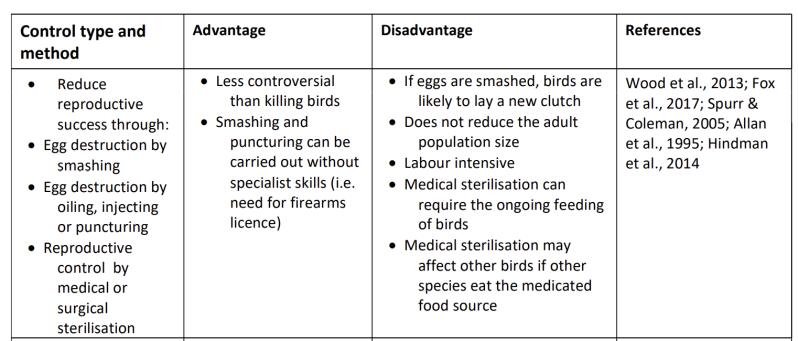
Taken from Report "Waikato Regional Council Technical Report 2019/16: Use of West Coast Waikato estuaries by Canada geese and
black swans"
https://www.waikatoregion.govt.nz/assets/WRC/TR201916.pdf
What is known: Auckland Council’s Pest Free team has already vetoed this. Released publicly about one month prior to the Motion and press release:
"The definitive answer from my colleagues in Biosecurity is that black swans are not a species Auckland Council is currently prioritising the control of because they are not classified as a pest in Auckland’s Regional Pest Management Plan (RPMP), and they remain legally protected under Schedule 1 of the Wildlife Act 1953 as a legal gamebird species in most parts of New Zealand. They are managed by Fish and Game New Zealand."
"Also, although large numbers of black swans may have some limited impact on water quality and avian influenza risk, black swans are not considered a major pressure on the regionally significant species and ecosystems. They do occasionally eat from zostera (seagrass) beds, but this is not their preferred food source (they prefer freshwater vegetation)."
And perhaps most farcically, in terms of the legitimacy of the proposed necessary actions:
What is known: Swans do not, and cannot, nest in open marine environments. As such, they can not nest in places such as St Heliers Beach and Okahu Bay. As such, there are NO EGGS to be oiled in these places.
WHAT this SHARED SPACE ACTUALLY LOOKS LIKE
And finally...
What is known: While much has been made by the local special interest groups about how the local residents cannot co-exist with the swans, the following photos and videos show the truth of WHAT IS, when the tide is in, the sun is out and people have flocked to the beaches. These videos were taken consecutively on the 18th October 2026.
Take a look for yourself and you will see across St Heliers and Kohimarama -
Long stretches of beach full of activity.
People and families of all ages - in the water, on the water, on the sand, on the grass, on the rocks, on the boardwalk
People completely undisturbed by the presence of the swans.
People walking Tamaki Drive and the beach - stopping, captivated, taking photos, sitting with and relaxing in the swans presence.
Long stretches of white sand beaches completely absent of swan poo.
Multiple human hazards, if you are really worried about "the children" etc.
To this end, I think it is worth revisiting the words of Professor James Russell, Specialist in Conservation Biology at the University of Auckland:
"decisions about culling need to be evidence-based. "When an animal is going to be killed, the evidence needs to be real. And there needs to be a high standard for the [evidence]." The wider community would also need to be consulted before culling was considered, he says. "Does everyone think that, or is there a large sector of the community that think 'no, it's beautiful that these large, gracious birds are now gracing our beaches and I'm more than willing to accept a bit of poo for that'?"
Russell says accusing swans of taking food from other seabirds can be a form of "scapegoating". Those who care deeply about seabirds should probably start concentrating on ways to solve climate change - "how much we drive our fancy cars and take our fancy holidays" - and overfishing, he says. "Even if the swans were taking some of their food, they're all fighting over such a diminished, collapsed ecosystem so we should probably be turning that finger back at ourselves.""
The cruel and misinformed call for culls
There is a substantial body of ecological and scientific evidence demonstrating that culling is structurally inefficient, and unnecessary for population management due to their specific biology and social behaviours.
The local population -
Within the Manukau Harbour and Tamaki Estuary, as in other areas, we have what is known as a non-breeding float made up largely of 'bachelor' groups and 'creches' - effectively encompassing swans between the ages of 6 months to 4 years old, with some adults who are non-breeders. They gather in peaceful, non-breeding communal flocks. Studies tracking swan species (such as the Bewick’s Swan) show that as nest density increases, pairs actively skip reproduction, reduce nest attendance, or experience lower egg hatching success. The birds self-regulate their output based on crowding. In the local area, this is already happening with no increase in nesting density. There is still only one viable nesting site, and one pair of nesting swans.
It is worth noting that increasing the human-induced distress to swans isn't going to help. In fact, the more stress they are under, the more likely they will gather in larger groups as these provide more safety, especially for younger swans. Local human-induced stressors have included deliberately blocking access to food and water; high prevalence of predators such as dogs and people; limited safe areas and times in which to come ashore and rest, preen, waterproof; high prevalence of high stress activities such as kitesurfing, kayaking, windsurfing, foiling in close proximity; inability to access foraging areas due to human interference or adverse weather; already high attrition rates; already high environmental pollutants; as well as the natural stressor of moult season when they cannot fly.
As mentioned previously -
- When calculated against the total biological potential of the clutches laid, the total survival rate from egg to one year old is 8.57% (3 survivors from ~35 eggs).
- There is a local recruitment rate of only 1% (three survivors) over nearly two years demonstrating a population that is heavily failing to replace its natural mortality rates locally.
- Global studies show the average survival rate for swans from hatched to adult (2-4 years old) is around 25 - 42%. In black swans, the long term data shows a cumulative survival rate of 25 - 35%.
International scientific and government literature confirm that swan populations organically stabilise without human culls.
- A seminal European overview published in the international journal Wildfowl examined decades of tracking data on the population trends of the Mute Swan in the Alps and Central Europe. The report showed that the swan populations naturally curved downward or plateaued on their own. Their growth was strictly capped by changes in regional carrying capacity (available winter food and aquatic vegetation) and natural winter mortality spikes during severe weather, rendering artificial control unnecessary.
- The Mute Swan Management Literature Review and Discussion Document synthesised dozens of prior scientific studies to evaluate if culling was ecologically justified. It found that the need for swan population management is completely unsubstantiated by scientific evidence.
The report debunked the standard justifications used to support culling, finding no proof that swans cause problematic population explosions, deplete long-term aquatic vegetation, or systematically outcompete native waterbirds for territory. It further noted that populations left alone stabilised harmlessly into their surrounding ecosystems via local density-dependent factors
- In New Zealand, black swans are managed primarily as gamebirds, and historically, local councils permitted culls to prevent agricultural grazing. In response, a detailed multi-year ecological study titled A demographic model to support customary management of a black swan population was launched at Te Waihora (Lake Ellesmere). The demographic modelling showed that large-scale lethal culling by government was an unstable and ill-fitting tool. The report showed that swan populations operate heavily on a highly localised scale influenced by specific habitat features, water levels, and natural food availability. When regional culls were reduced, the population did not spiral out of control; instead, natural environmental pressures and localized movement naturally balanced out their numbers.
- The Netherlands undertook a formal Risk Assessment of the Black Swan in the Netherlands using the international Harmonia/ISEIA guidelines to determine whether black swans would overpopulate or harm the native ecosystem. It found that high population densities were highly unlikely to occur due to natural climatic and ecological barriers. The swans safely shared resources with native mute swans, and the ecosystem naturally restricted their growth to negligible levels without requiring any government intervention or lethal management
- A comprehensive study published in the journal Bird Study by researchers at the University of East Anglia examined Mute Swan Population Trends in Great Britain following a national ban on lead angling weights and concerns from some that this would result in a "population explosion". The study used advanced mathematical modeling to prove that the population expansion was strictly capped by available food resources—specifically the density of autumn-sown arable crops. The data showed that rather than growing infinitely, the national swan population naturally plateaued and stabilized in alignment with agricultural patterns and regional environmental changes, rendering culling entirely unnecessary.
- A landmark 30-year dataset tracking over 10,000 wild swans in the UK, published in the Proceedings of the National Academy of Sciences, evaluated how swan populations distribute themselves across 22 UK sites. The researchers discovered that while whooper swan populations grew dramatically (by 6% annually) inside highly protected, resource-rich nature reserves, the growth rate outside these reserves naturally dropped to a negligible 0.2%. Instead of overcrowding or overpopulating a single area, the birds self-regulated through a natural "spillover effect". When the density inside a nature reserve reached maximum carrying capacity, competitive and territorial pressures naturally forced the swans to migrate and disperse into non-protected areas with lower densities. The ecosystem organically balanced its own bird distribution without human intervention.
- The UK government tracks waterbirds through the long-running Goose and Swan Monitoring Programme (GSMP) and the Wetland Bird Survey (WeBS). The 2024–2026 WeBS reporting revealed that mute swan numbers across England, Scotland, and Wales dropped to their lowest level in 25 years. This major population correction occurred entirely due to natural environmental pressures—specifically, severe outbreaks of Highly Pathogenic Avian Influenza (bird flu), which heavily impacted mute swans. Density-dependent factors like disease naturally downscale the numbers, making human-engineered population control redundant.
- Where NZ regional authorities refused to carry out swan culls, historical data demonstrated that swan populations did not spiral out of control. In Tauranga Harbour, for example, where swans number between 800 - 6000, local authorities rejected public calls to cull them.
Unsurprisingly, subsequent long-term aerial monitoring by Fish & Game and local environmental departments proved that numbers naturally fluctuated and stabilized on their own - in line with all international consensus on the issue.
"Fish & Game rule out swan cull - Sun Live, 9 September 2015:
The number of black swans in Tauranga Harbour does not require a cull, says Fish & Game.
'Our counts indicate the swans don't appear to be the problem they've been painted in some media and other reports,” says senior Fish & Game officer Matthew McDougall.
'There's evidence that numbers rise for only a small part of the year, so we see no need for any immediate drastic controls.”
Fish and Game staff increased their monitoring of the black swans in the harbour in response to public calls for the numbers to be reduced.
Monitoring included aerial counts carried out at different times of the year using light aircraft.
Black swan populations fluctuate according to the season. The numbers decrease in autumn and winter and increase again in spring and early summer.
In January this year, there were less than 6000 birds – a figure which fell away to 800 August.
'We've known for some time that black swan move away in about May to areas such as the Rotorua and Waikato lakes,” says Matthew.
Any move to cull or control the birds on Tauranga Harbour could harm Waikato populations which have already taken a 'huge knock” from the disappearance of weed beds in that region, adds Matthew.
Black swans are native birds and the harbour is part of their natural habitat.
If sediment flows into Tauranga Harbour were reduced through more catchment protection measures, the seagrass beds important to juvenile snapper could easily cope with the black swan numbers.
'Initiatives such as fencing streams and planting, like the work spearheaded by the Whaingaroa Harbour Care group in Raglan, would be very beneficial,” he adds.
The Eastern Fish and Game Council, which manages sports fish and game birds in the region, is responsible for keeping populations to a manageable size so they don't have a detrimental effect on the environment or users of the harbour.
My proposed "Motion" amendments for the olb
education: "In the age of information, ignorance is a choice". At a bare minimum, promote the DOC guidelines when it comes to their protected and native status and the co-existing expectation that the public (and their dogs) remain 20 metres away from all protected wildlife.
gratitude: for how ridiculously fortunate local residents are to have access to wild spaces, that wildlife calls home. It is not our home, we are just guests in these spaces.
choice: if you don't like the 'wild' in wild spaces, go somewhere else. There's plenty of alternate coastline nearby.
responsibility: It is not up to wildlife to understand the wants of humans; it is up to humans to understand the needs of wildlife.
discipline: its not hard to not harm. Do better.
respect: for nature, for others, for wildlife.
enforcement: of irresponsible dog owners, of breaches to the wildlife act, of cruelty to animals.