WORLD ANIMAL PROTECTION (WAP)
Animal sentience refers to the capacity of animals to have subjective experiences, thoughts, feelings, and individual personalities. Scientific research irrefutably proves that animals can experience a range of emotions, both positive and negative.
Animals have their own distinct inner lives, preferences, desires, and needs. While we may not always fully comprehend what they are, we can use our understanding of animal sentience to monitor and measure their emotional well-being. By doing so, those who care about animals can do a better job of not causing pain and distress, and ensuring they experience positive emotions as well.
What is sentience?
Sentient comes from the Latin verb sentire, which means “to feel”. Sentience is the ability to feel a range of emotions and feelings, such as pleasure, pain, joy, and fear.
Are animals sentient beings?
Yes! While it is most commonly recognized that mammals possess sentience, advancements in scientific research and an increasing body of evidence have demonstrated that an ever-expanding circle of animals, including fish, birds, and even invertebrates, also exhibit signs of sentience.
Animal sentience refers to animals’ ability to perceive and experience emotions like joy, pleasure, pain, and fear. Some animals are even capable of experiencing more complex emotions such as grief and empathy, such as elephants. Recognizing animals as sentient beings emphasizes the importance of their emotional as well as physical well-being.
The acknowledgment of animals' ability to experience both positive and negative states serves as the driving force behind the animal welfare movement and the reason why laws aimed at protecting animals exist.
What makes an animal a sentient being?
Our understanding of animal sentience still varies depending on the species, as some groups of animals, such as mammals, have received far more attention than others.
Vertebrate species
It is generally accepted that vertebrate species are sentient. This includes mammals, birds, reptiles, amphibians, and fish.
Birds
Although birds have evolved different brain structures to ours, they still have what they need to process experiences and feel emotions. In fact, chickens demonstrate empathy, and magpies appear to feel grief. Studies on avian species such as corvids (crows and ravens) have revealed their advanced problem-solving skills, tool use, and complex social interactions.
Why is animal sentience important?
Many people underestimate the significance of an animal's emotions or dismiss them as subjective and difficult to comprehend or quantify. However, this is not accurate. Over the past two decades, scientific knowledge about animal sentience has greatly advanced.
Scientists now have a wide range of tools to measure and understand the emotional experiences of animals, and these can be used to ensure that animals have the lives they deserve. For instance, by observing postures and behaviour, we can gain valuable insights into how animals feel. The study of animal sentience is also uncovering the remarkable abilities of different species.
To truly understand animals' perspectives and ensure that their voices are heard, it is crucial for us to continue our work to educate and raise the public’s understanding of animal sentience.
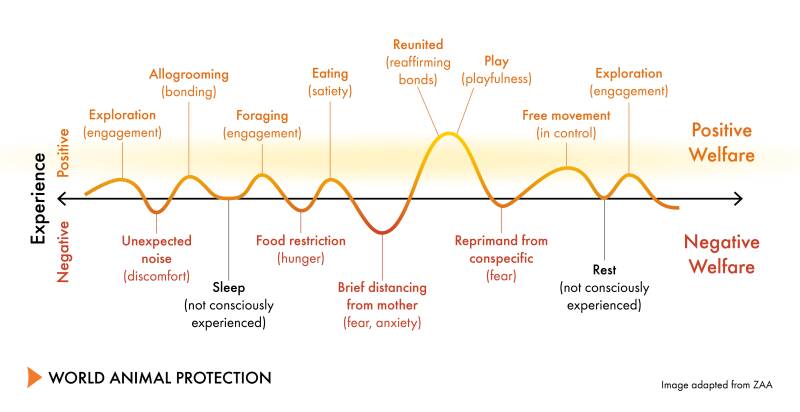
This diagram shows how animal welfare is a continuum.
An animal’s daily experiences continuously contribute to an animal’s overall welfare. Just like humans, it’s normal to experience some negative experiences (e.g., thirst), but the goal is to ensure that negative experiences can be solved (e.g., access to clean and unlimited water sources) so that an animal’s overall welfare is positive.
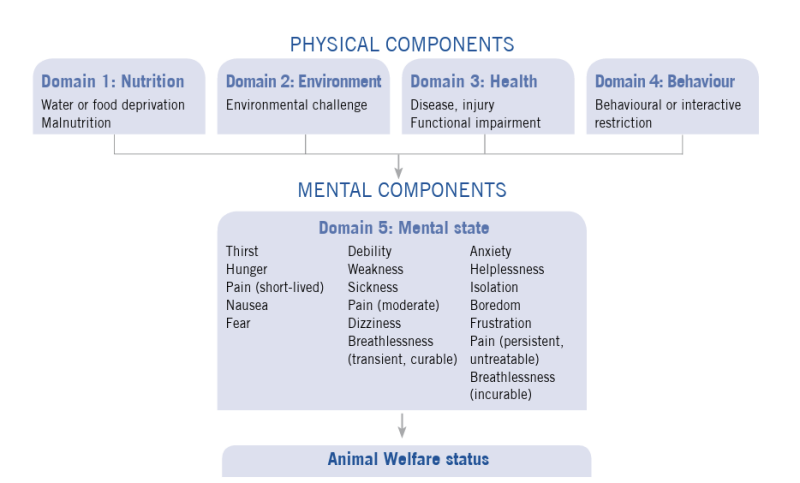
The Five Domains model goes further than the Five Freedoms in that it places more of an emphasis on an animal’s mental state and ability to have positive experiences. It highlights that emotional needs are equally important as physical needs, and that physical needs can impact emotions.
All animals deserve a good life.
SPCA
Ministry for Primary Industries (MPI) - New Zealand